
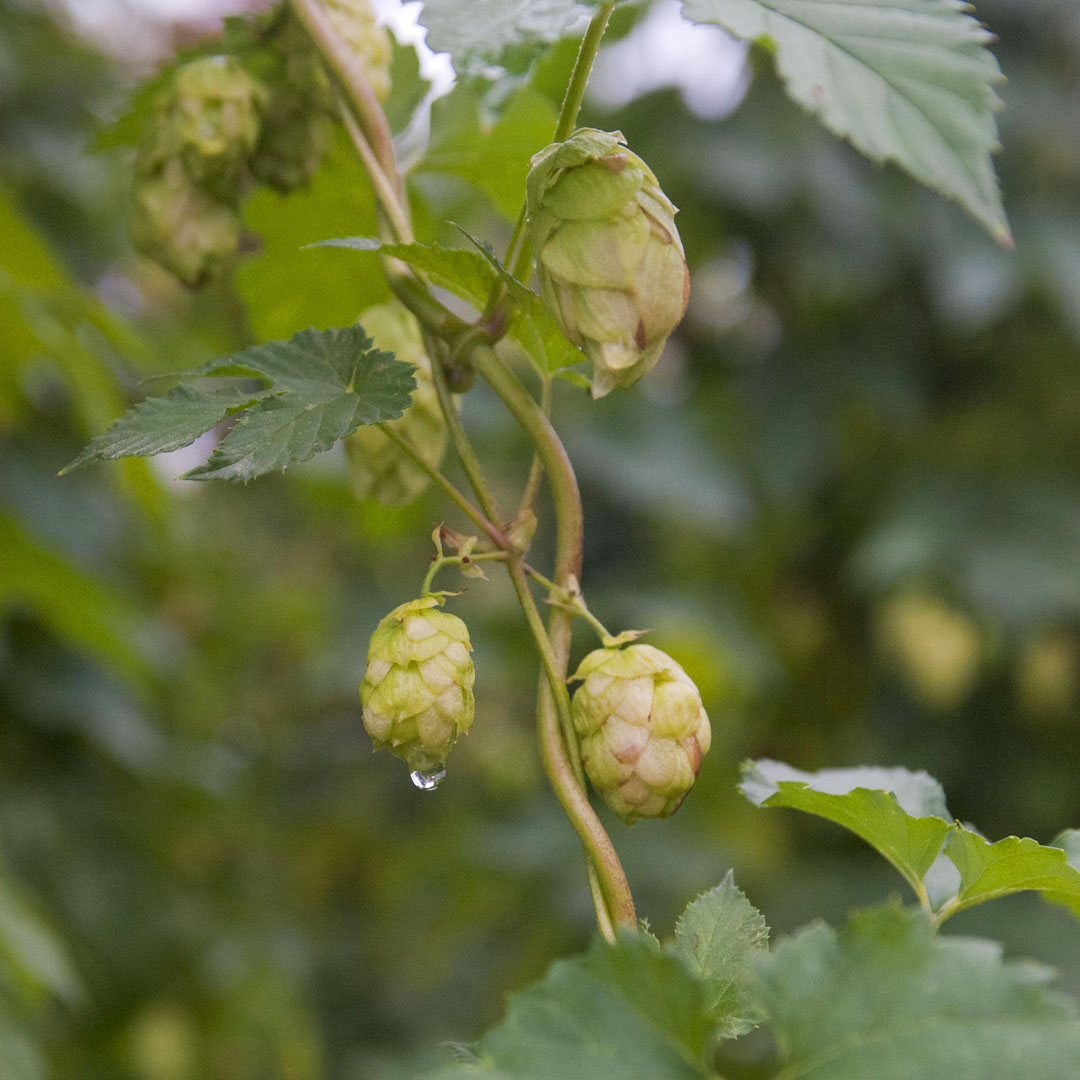
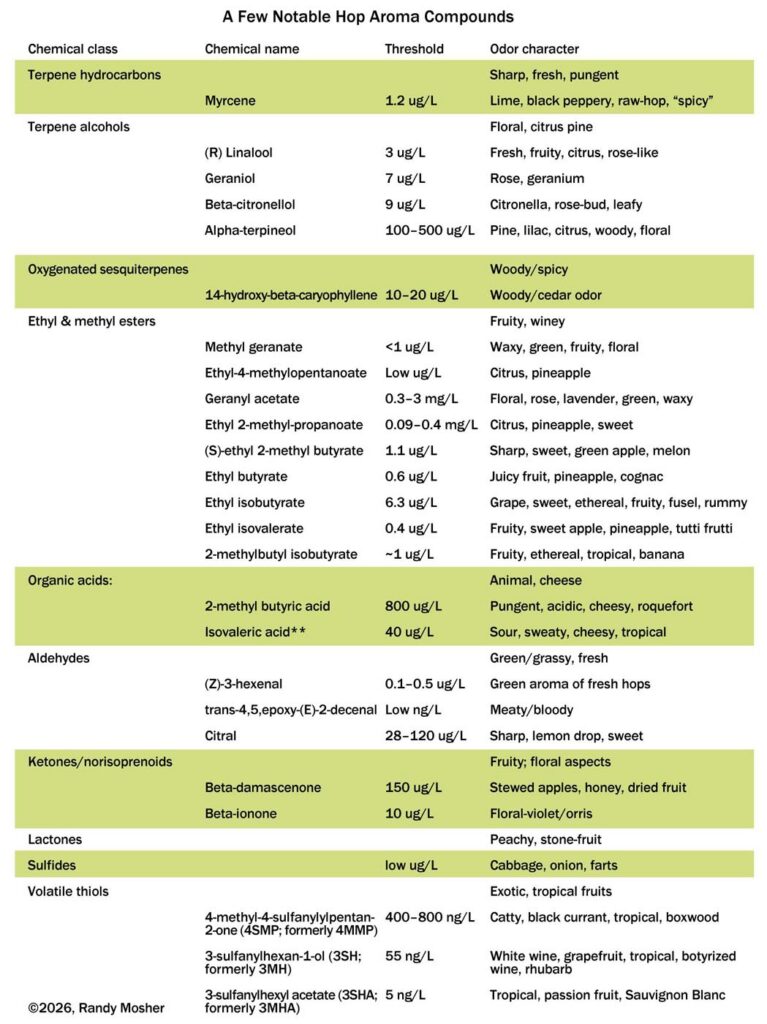
Long an indispensable flavoring ingredient in beer, hops famously have one of the most complex aromas of any botanical ingredient. Hop experts I know suggest that there are at least 700 known terpenoids in hops, and that’s a conservative estimate. And as you can see from the chart below, there are many other chemical types contributing different characters to hops’ amazing aromas.
With their pine to floral to citrusy personalities, terpene hydrocarbons and their more soluble and stable terpenoid derivatives form the backbone of hops’ intoxicating aroma. Interestingly, no single one of them smells exactly like hops. The reason for this is revealing of the way we actually smell complex odors.
One might assume that with enough sensitivity and experience, an expert could pick out any individual terpene-related compound that sticks its head above threshold. This is generally not the case. Instead, scientists have increasingly found that with closely related odorous chemicals that rely on close-knit groups of receptors, the individual chemicals give up their own identity for the sake of a kind of a merged character resembling none of its components. Scientists call these “configural” odors. This not only happen with hops; many other odors we know work this way.
This phenomenon is complicated and is still not fully understood, but here’s what’s known. Most chemicals can trigger responses from multiple olfactory receptors. With few exceptions, most receptors can respond to multiple chemicals. This creates a complex pattern of receptor responses that the brain uses to recognize odors. The patterns are made even more complex by the fact that responses can be positive, negative or null and typically change with the concentration of the odorants. There are also a lot of synergistic or suppressive interactions. Much of these interactions occur at, or even below what is considered their normal threshold values.
Configural odors act as merged “pools” of aroma that often change little even when significant numbers of their components are removed. Scientists studying fruitiness in wine found that of the 14 most important esters in a white wine’s fruity nose, they could remove all but one and still have more-or-less the same fruity character. Although the same experiments haven’t yet been done with hoppy aromas in beer, my hop-world friends expect to find something similar going on, and there’s other evidence for it.
Why would smell behave like this? It likely has much to do with the way the brain processes odors. While it uses these complex receptor response patterns to identify odors, as soon as it has done so, there’s no further use for them. They’re monstrously complex and really aren’t in the kind of neural format the brain easily works with, so they never enter the brain. Instead, our minds tag odors with meaning, context, value and other psychological qualities.
It is possible to identify a few of the specific terpenic aromas sometimes: floral, like rose or geranium, lemon or orange, maybe a whiff of lavender. But pegging specific compounds is pretty chancy unless you have a ton of experience.
Beyond terpenes, there are several other chemical types contributing to hops’ complex aromas, as you can see in the chart. Many of these participate in the pooled aromas, pushing them slightly in one direction or another. Some, like the norisoprenoids. are strong potentiators of fruity flavors and are also important in wine. Beta damascenone may also be present as a kind of blackcurrant or raisiny character in over-aged IPAs and other hoppy beers. Super-potent thiols are also strong potentiators of fruitiness and can bring pleasing grapefruit or tropical fruit characters. But this is concentration dependent; too much and you veer unpleasantly into cat-pee territory.
Organic acids can bring unpleasant cheesy off-odors, most notably from hops stored in poor conditions. Thankfully, sulfides in hops are rarely picked up in beer, although dimethyl sulfide (DMS) is a known potentiator of fruit aroma in wine, and may play a similar role here.
Browsing through the list of flavor descriptors of these contributors to hop aromas conjures up a whole produce section, complete with flower shop attached. The hop’s enduring popularity derives from its enchanting, chameleonic personality. Forever fresh, bright and lively, they never get old for me.
Further reading:
Christina Dietz, “The multisensory perception of hop essential oil: a review,” Journal of the Institute of Brewing 126, No. 4 (2020): 320-342, https://doi.org/10.1002/jib.622.
Kiyoshi Takoi,”Flavor Hops” Varieties and Various Flavor Compounds Contributing to Their “Varietal Aromas”: A Review,” MBAA Technical Quarterly 56, No. 4 (2019): 113–123, https://doi.org/10.1094/TQ-56-4-093-01.
Kiyoshi Takoi, “Behaviour of hop-derived branched-chain fatty acids during fermentation and their sensory effect on hopped beer flavours,” Brewing Science 72 (Nov/Dec ): 19–24, https://doi.org/10.23763/BrSci19-24takoi
Nils Rettberg, “Hop aroma and hoppy beer flavor: chemical backgrounds and analytical tools—a review,” Journal of the American Society of Brewing Chemists 76, no. 1 (2018): 1-20, https://doi.org/10.1080/03610470.2017.1402574.