
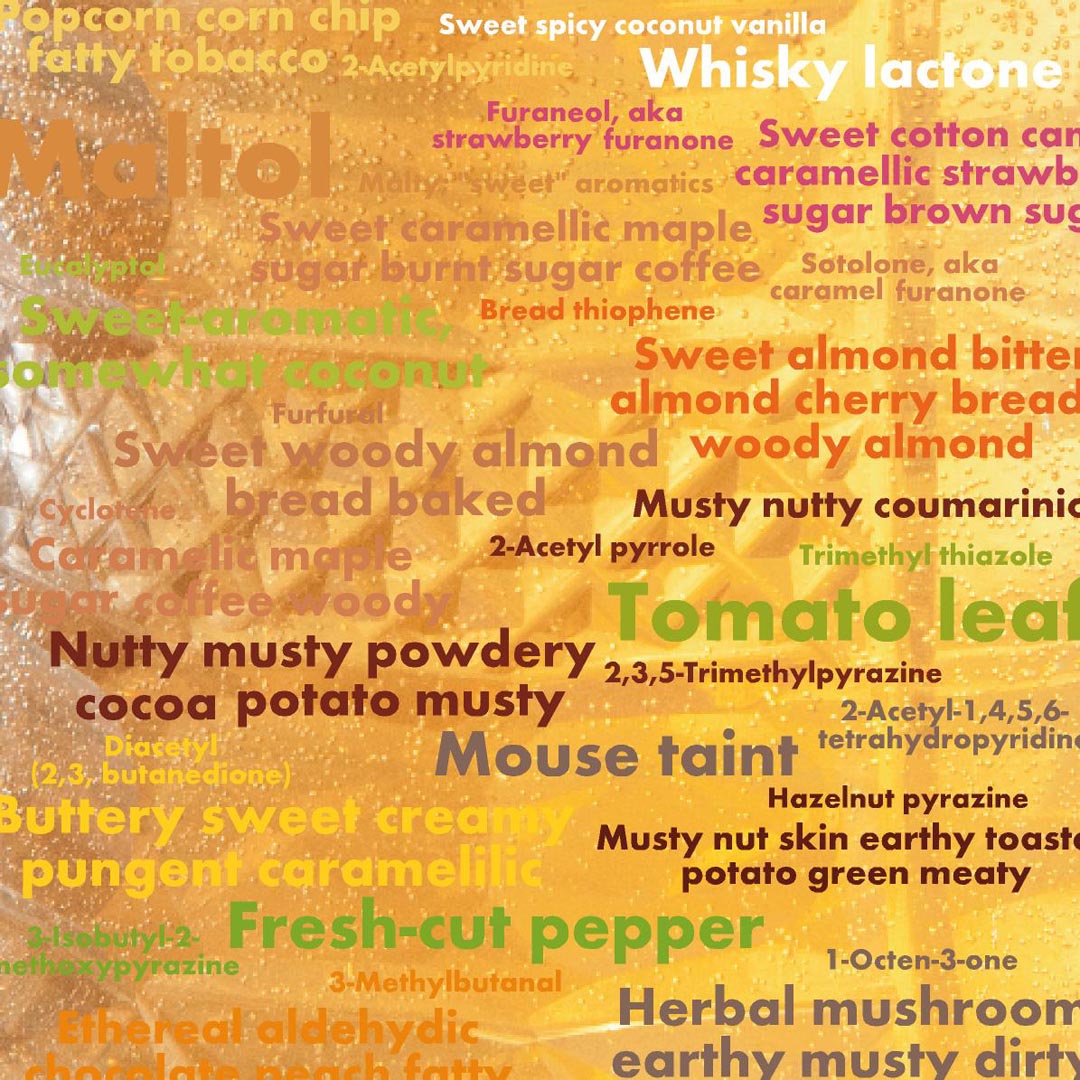
This chart lists some selected products of kilning, baking, roasting, frying and other cooking methods. Just to put it into some kind of context, these flavorful chemicals arise from several fearsomely complex chemical processes involving heat: Maillard browning, caramelization and pyrolysis, which is essentially burning.
These are active in all cooking processes, and over time, may even happen at room temperatures, too. The specific mix in any one food or beverage depends on the starting ingredients (precursors), time, temperature, moisture level and other factors. This explains the difference between, say, coffee, chocolate, roasted meats and dark malts.
The chart is arranged with the shortest time and lowest temperatures on top and more fully heat-blasted ones towards the bottom. It’s also important to know that the flavor chemicals created early in the process often degrade or change into something else as time + temperature increases.
Don’t be put off by the complex chemical names. Just wonder in amazement of the variety and specificity of them—this is just a small subset—and how they reflect so many aspects of cooked foods and products like beer.
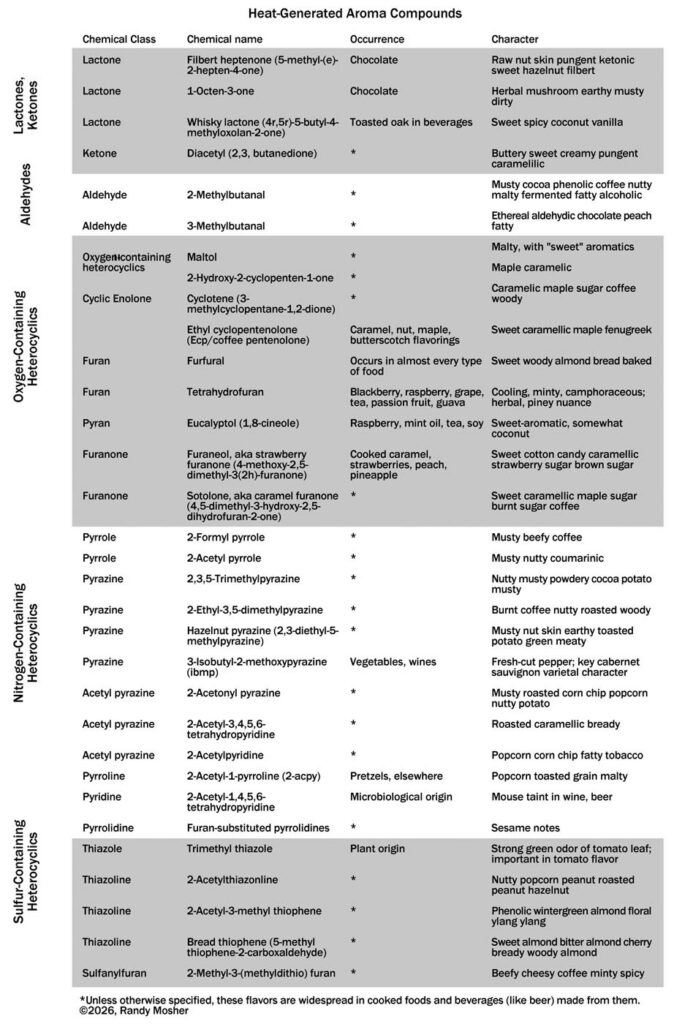
Odor descriptions are from GoodScentsCompany.com
Note: I have talked to a couple of malt chemists to see if anyone had the information to essentially add another column to this chart: specific malt types displaying characters of the chemicals listed here, but came up empty. I could guess, but know there must be solid science out there somewhere. If anyone has a lead on this, drop me a line and let’s talk.
References for the chart:
Gary Reineccius, Flavor Chemistry and Technology, 2nd Ed. (CRC Press, 2005). ISBN-13: 978-1566769334
Stefan Coghe, “Effect of non-enzymatic browning on flavour, colour and antioxidative activity of dark specialty malts—A review,” Monatsschrift fur Brauwissenschaft 57 (2004): 25–38.
David J. Rowe, Chemistry and Technology of Flavors and Fragrances (Wiley Blackwell, 2004). ISBN-10: 9781405114509
Jiyoon Cha, T. Debnath, & KG Lee, “Analysis of α-dicarbonyl compounds and volatiles formed in Maillard reaction model systems.” Scientific Reports 9, (2019): 5325, https://doi.org/10.1038/s41598-019-41824-8
Raphael Prado, “Aroma and color development during the production of specialty malts: A review,” Comprehensive Reviews In Food Science And Food Safety 20, no. 5 (2021): 4816-4840, https://doi.org/10.1111/1541-4337.12806.
Caroline Scholtes et al., “Guaiacol and 4-Methylphenol as Specific Markers of Torrefied Malts. Fate of Volatile Phenols in Special Beers through Aging,” Journal of Agricultural and Food Chemistry 62, No. 39 (2014): 9522–9528, https://doi.org/10.1021/jf5015654