
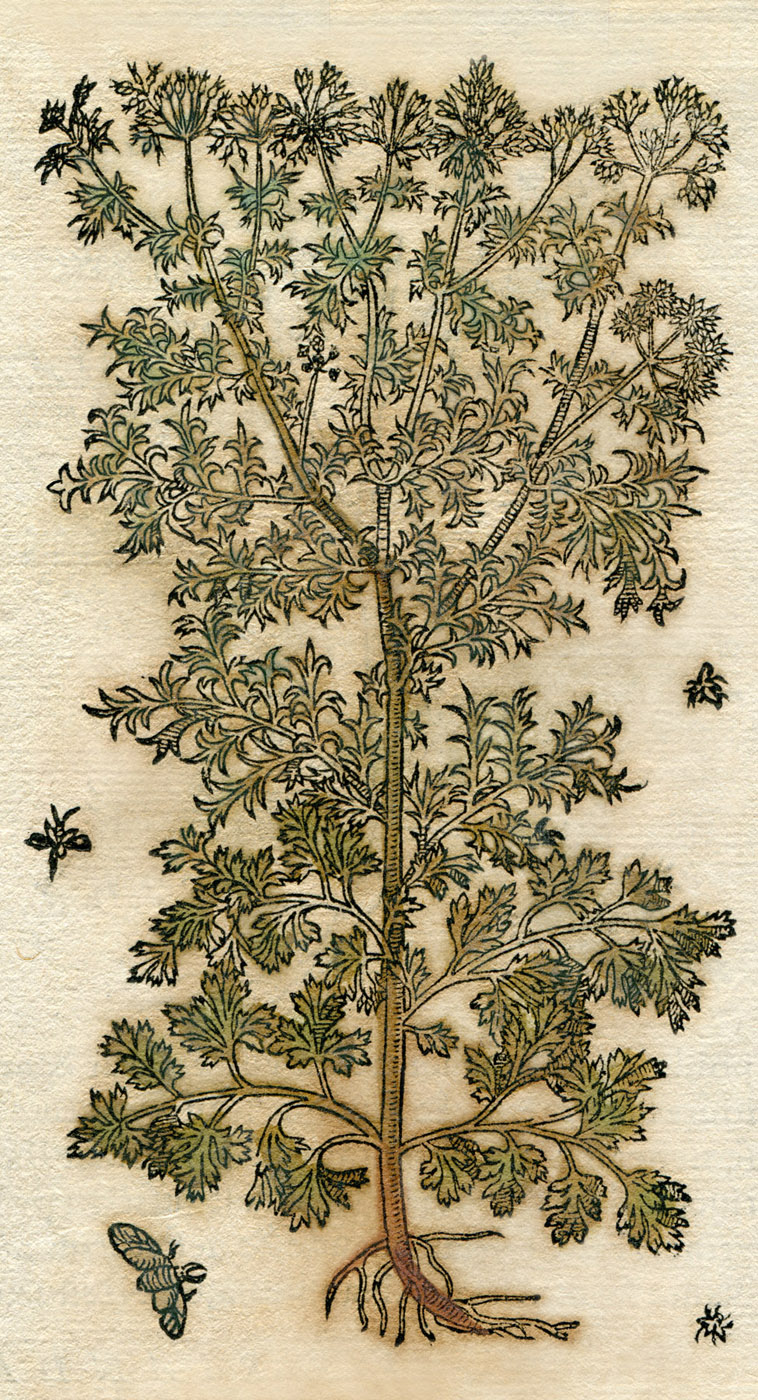
I love to cook, and do so almost every day. As someone with a creative bent, I want to make sure I have access to the widest possible range of flavors to work with, just as an artist would want to have a lot of colored paints at hand. Some seasonings have very specialized uses and stay in the cabinet, but others are used so often I keep them on a rack right above the cooktop. Most herbs and spices are best suited either for savory foods or sweet ones. A few, like ginger, have shape-shifting characters that lets them do dual duty. Of these, coriander is the king in my kitchen.
Originating in the Mediterranean and Middle East, coriander has a long history. It is mentioned repeatedly in the Bible, and found use across the region in ancient times. More than just a seasoning, it has long been used as a medicine, and science today is validating the medical efficacy of its terpenes and polyphenols.
Coriander is a member of the carrot or Apiaceae family. Its leaves are rich in aldehydes: a chemical group famous for grassy/greasy characters. It’s quite polarizing, so its uses are more limited to Mexican and Asian cuisines. Here, we’re talking abouyt the ‘seeds.’ Called called cremocarps in botanical terminology, each easily separated half (mericarp) of the little ball contains a small seed inside. If you look at them closely, they have raised stripes radiating from the stem end to the apex. These are actually hollow tubes filled with aromatic oil that gives coriander its lovely fragrance. By weight, the yield of essential oil varies from 0.03 to 2.6 percent. Like most spices, coriander seeds are rich in chemicals called terpenoids: abundant in flowers, citrus, herbs and spices.
For those of us interested in beer, terpenioids are the very soul of hops, contributing those same floral and citrusy qualities. So it’s no surprise that coriander seed has been used to flavor for beer for centuries, and is still featured in wheat beers like witbier and gose, where it adds orangey, floral notes that perfectly complement the hop aromas, shifting the balance slightly off center in an enjoyable way.
One of my favorite beer styles is Belgian Witbier. I rarely miss an opportunity to taste some new interpretation, but I’m frequently disappointed. To be fair, there’s a lot of ways to screw up this subtle beer style. Strangely, brewers who are obsessive about the subtleties of hops often seem to just grab whatever coriander seed is at the grocery store, sometimes with disastrous results.
Just like hops and other cultivated plants, coriander’s aroma is very sensitive to cultivation conditions and even more so to its varietal strain. Some coriander, especially of Mexican origin, has a bit more of a cilantro character. This fatty, soapy quality is very much on the savory side of flavor: great for tacos, but lending a kind of “hot dog water” character that does beer no favors. From what I have red, the amount of these cilantro aromas also depend on the ripeness of the seeds, as those aldehydes disappear towards maturity as the terpenoids build. Middle Eastern or Mediterranean coriander from Egypt are considered standard culinary types in Western cuisine, and these are fairly well balanced and potent in flavor. Indian varieties tend to be less potent, but make up for this with a pleasing orange-and-lavender character that’s very nice in beer. One chemically distinct thing about most Indian varieties is higher amounts of an ester, linalyl actetate, with a woody bergamot and lavender character.
Another classic use of coriander is in sausage-making. It is the classic seasoning in hot dogs and indeed this is where its flavor is most prominent. In bratwurst, it is paired with white pepper and another terpene-rich spice, mace. You’ll also see it in kielbasa recipes (along with marjoram and garlic) and various kinds of bologna including classic mortadella. Beyond food, coriander is a employed in many liqueurs and is—after the obligatory juniper—one of the more important botanicals in gin, where its terpenoids join the party with citrus peel, grains of paradise and others.
I’ll admit to being a little obsessed with coriander. My back-stock includes varieties from China, India and the Middle East. I keep a big pepper grinder filled with a blend, as each location and cultivar produces quite different characters. One important fact is that like many herbs, coriander degrades in storage. This is especially true for ground coriander, which I have always found to be absolutely useless—like sprinkling cardboard dust onto your food. Find a pepper mill at a church rummage sale and keep it handy, filled with whole seeds. You may be astonished at how aromatic it can be.
In terms of culinary use, I use it for nearly everything, as it does a nice job of adding background complexity while rarely calling attention to itself. Because of its citrusy qualities, I think of it as a way to give foods a bit of a “lift,” much as you would add a squeeze of lemon. Indian food depends heavily on it, and it’s useful for Mexican food as well, blending nicely with chile and Mexican oregano flavors. It’s also used in Chinese dishes, where small-seeded varieties add piney, camphor and even cooling qualities. 5 Lizard, the lime and passionfruit beer we brewed at 5 Rabbit Cervecería, used Chinese coriander to very good effect, adding a lot of depth to the fresh lime peel we used.
Because there is so much variety between varietals and localities, having a wheel for vocabulary can help one disentangle the various flavors and even characterize a particular varietal. The spider-web in the middle can be used to build a chart of a coriander’s aroma profile. Put a dot corresponding to intensity of a particular aroma aspect on each labeled apex, with zero in the center and five at the outside. When done’ connect the dots and you get a jagged star-shaped polygon that can be compared to other types.
Here’s a coriander flavor wheel I created:

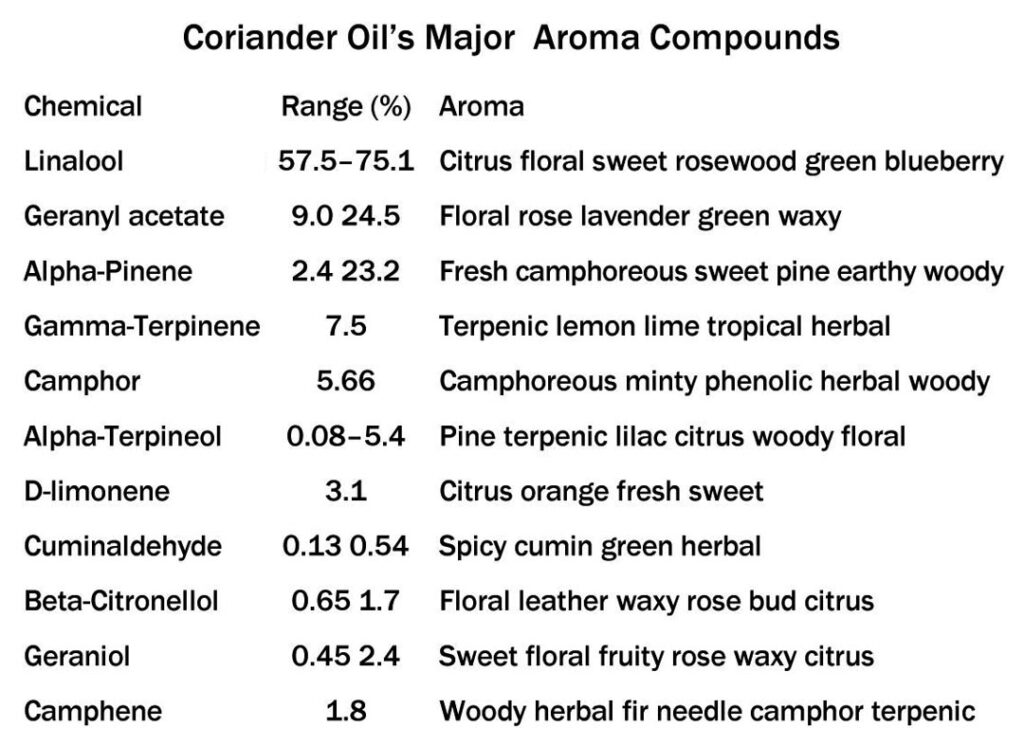
If you’re interested in the chemistry, more than 40 aroma compounds have been identified in coriander, most of them terpenoids. These run the classic gamut of citrus and floral characters without getting too perfumy. Coriander’s most dominant aroma compound is linalool, a terpene alcohol. It is usually described as orange, lavender and well, coriander in character. There’s so much linalool in coriander oil that the seeds are actually the starting point for pure linalool production.
Here’s a list I cobbled together from the references below of the most important aroma compounds, with quantities stated in the papers, which will give you a rough idea of their relative proportions:
I would strongly encourage you to get out to the ethnic markets and pick up some of the amazingly varied types of coriander that are available. Since many cuisines use spices quite liberally, a side benefit is that you might pick up a pound for little more than what you’d pay for a couple ounces in the grocery store. It’s easy and fun to make up your own custom blend to take advantage of the range of flavors available. You might even find yourself asking “How did I ever get along without this?”
References:
K.V. Peter, Handbook of Herbs and Spices, Vol. 1, second edition, 216–2 (2012), Woodhead Publishing, Limited.
R. Ravi et al., “Aroma characterization of coriander (Coriandrum sativum L.) oil samples,” European Food Research and Technology 225, (2007): 367–374, https://doi.org/10.1007/s00217-006-0425-7.
Muhammad Khuram Shahwar et al., “Characterization of Coriander (Coriandrum sativum L.) Seeds and Leaves: Volatile and Non Volatile Extracts,” International Journal of Food Properties 55, no.4 (2012): 736-747, https://doi.org/10.1080/10942912.2010.500068.
Aneta Pater et al., “Effect of Coriander Seed Addition at Different Stages of Brewing on Selected Parameters of Low-Alcohol Wheat Beers,” Molecules , 29 No. 4 (2024): 844; https://doi.org/10.3390/molecules29040844.