
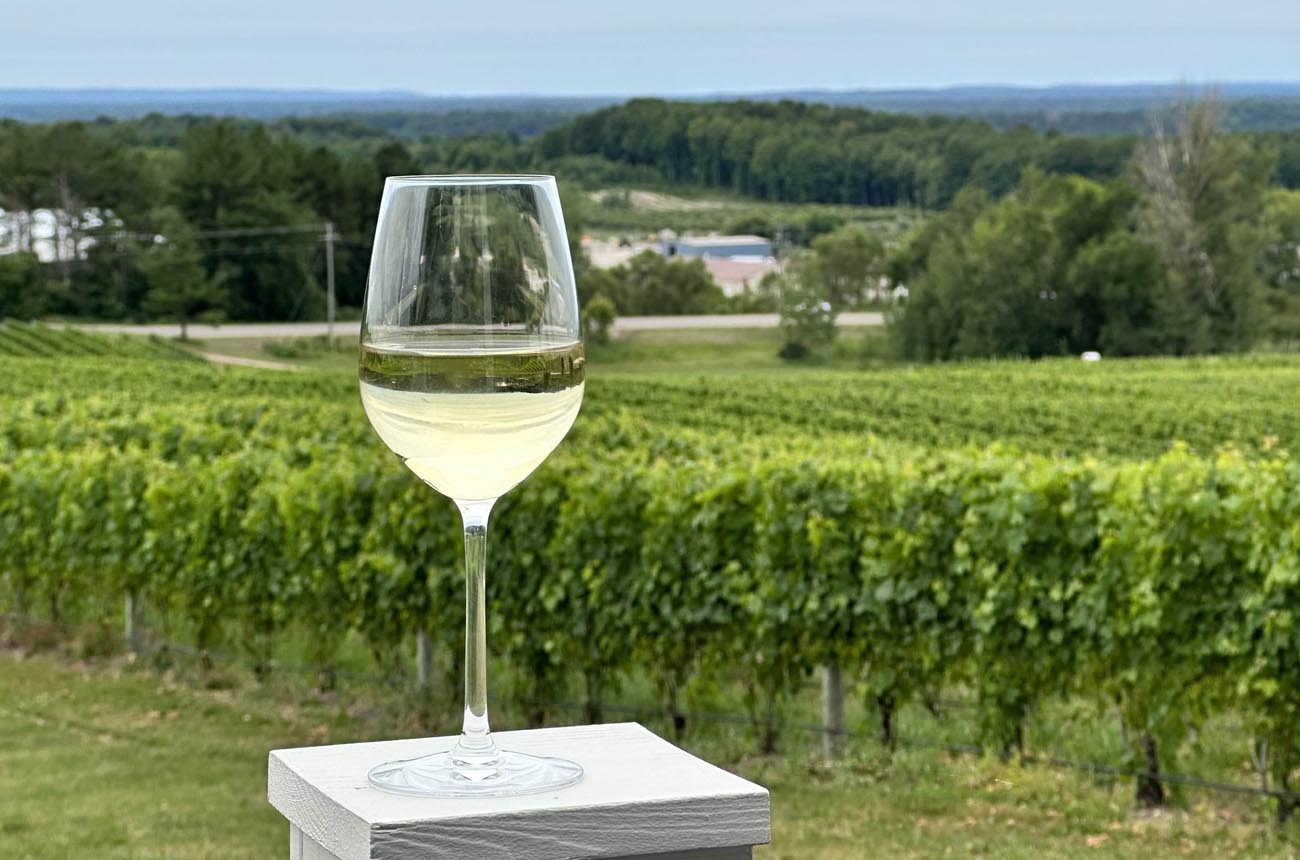
Writing about wine is scary. First, I’ve been a beer guy for decades, so I really have no bona fides in the rarified world of wine. Intentionally or not, wine throws up a lot of barriers: cost, social status, confusing labeling, insider “winespeak,” and often a dearth of even the most basic facts about what makes a particular wine tick.
It’s not like I don’t like wine or have limited tasting experience with it. I’ve read a ton, and visited viticultural areas in the US and abroad. I’m always trying to expand my knowledge and vocabulary. I just read every word in Ian d’Agata’s massive 640-page The Native Wine Grapes of Italy. Recently I’ve read dozens of current papers on all aspects of wine science. So I’ll just charge ahead.
It appears that writing about wine is challenging even for insiders. There is a fair amount of controversy in the field over the accuracy and value of reviews even by prominent wine critics. Few are able to identify a wine by its written description, even when they were the one who wrote it. Many descriptions seem to be completely untethered to reality.
For the new book, I needed to find something to say about wine that gets to the root of how its flavors are created and change over time. While the stupefying complexities of terroir are undoubtedly central to understanding any one wine, it’s easy easy to get lost in that labyrinthine rabbit-hole, and miss the vineyard by focusing on the vines. Since most people interested in wine likely have boatloads of resources along those lines, I decided to skip it all and focus on a few basic questions I had never seen addressed in my stack of books or in conversations with sommeliers or tasting room staff.
Like, where does the fruitiness of wine come from? Why does white wine smell so different from red, considering that the juice inside is usually not that different. What is “bouquet” aroma? What happens when wine ages? And what on earth is meant by “minerality?
1. Wine grapes contain very few fruity-smelling chemicals. So where do wine’s fruity aromas come from?
Short answer: fermentation. Esters form when a fatty acid and an alcohol combine, in this case produced by yeast. The mix of fatty acids are considered precursors to fruity flavor, varying considerably between grape varieties and under differing conditions. Grapes contain some fruity/floral alcohols and differing amounts of terpenes with floral and citrusy aromas, plus a few odds and ends. All may contribute to a wine’s overall aroma character, sometimes in unique ways.
That said, however:
2. A wine’s unique aroma character is not particularly dependent on the esters present.
Studies using reconstituted “model” wines have clearly demonstrated that the specific mix of the two or three dozen fruity esters likely to be smellable doesn’t matter all that much. Aromatically, the esters fuse together into a robust fruity aroma percept that doesn’t change all that much even when many are removed, or in one study, all but one.
That brings up another point:
3. “Bouquet” aroma is dependent on a specific sort of esters.
Fruity-smelling acetate esters dominate the aroma of young wines, both red and white. In the chemically dynamic mix that is wine, though, nothing lasts forever. Wine’s considerable acidity hydrolyzes (splits) these esters back into their alcohol and fatty acid components. These are free to re-form into larger branched-chain esters with vinous, cognac-like and “black fruit” aromas, all of which are characteristic of matured red wine. I haven’t seen a study similar to the one above, but it would be expected that the specific ester mixture wouldn’t matter all that much. Of course, flavors derived from wood—mainly cake spice-like—also have a strong impact.
3. The difference between the aroma of red and white wines is strongly shaped by things that you can’t directly smell.
Differences in ester types may not be the most important thing. In fact, wine aroma is very strongly impacted by chemicals in the wine that have little or no odors of their own. Although this seems counterintuitive, this makes sense when you know one fact: wine’s aromatic components have varying degrees of solubility in water and alcohol. Esters in particular are much more soluble in alcohol than water. Since what evaporates into the glass must leave the wine, higher solubility in alcohol means a chemical is more likely to stay put and therefore less likely to make its way out of the wine and into your nose.
This is termed “flavor release,” and even the 27 percent increase from an 11 percent white wine to a 14 percent red wine has a significant impact. There are other factors, too. Tannins and other polyphenols in reds make up an important component in what is termed wine’s “matrix,” or non-aromatic base. These chemicals have the ability to differentially latch on to certain chemicals, making their release even more unlikely.
4. What makes wines made from certain grape varietals really distinctive?
Grapes contain many aromatic compounds that do not meld into the vague fruity or vinous ester pools that give wine much of its base smell. These are from several different chemical families: Terpenoids, thiols, norisoprenoids and more. These “character impact” molecules don’t always submerge themselves into a wine’s overall aroma, and are sometimes perceptible individually. This is why knowing them is helpful for those learning to blind-identify various wines for sommelier exams. A hint of litchi, bell pepper, violets or black pepper can be crucial giveaways.
5. Fruity potentiation is a big deal.
Several chemicals can enhance fruitiness, either the fresh, white wine kind or the black fruit of aged reds. Some, like acetic acid and the creamed-corn funk of dimethyl sulfide, manage to enhance fruitiness when they themselves can’t be picked out of the mix. In wines like Sauvignon Blanc, sulfur-containing thiols can do the same trick.
The dark side side of this kind of interaction is that some chemicals are really great at masking positive aromas. Famously in corked wine, musty-smelling chlorine compounds like TCA actually interfere with olfactory neuron cell’s transduction process, literally throwing a molecular wrench into the works. The result is significantly diminished aroma and pleasantness.
6. Minerality seems like a real thing, but actually it’s not.
I’ve long been perplexed by this term, and no wine enthusiast I’ve ever talked to to has ever been able to name a single chemical contributing to this supposedly terroir-induced characteristic. Still, wine people talk about it all the time, mostly as a touchstone for quality whites. Here’s what it’s not: actually minerals picked up by the plants from the soil and deposited into the grapes, and then into the wine. Plant physiology simply does not work this way. The use of the term has been well researched. It seems to mean different things in different wine regions, often associated with aciditiy or the presence of sulfites, which brighten fruity aromas and sometimes add a sharp, crisp edge.
The use of the term, I think, is just a manifestation of the extreme difficulty of turning a multifaceted product like wine into meaningful words, a task for which both our sense of smell and our language are poorly suited to.
References:
Vicente Ferreira, “A New Classification of Perceptual Interactions between Odorants to Interpret Complex Aroma Systems. Application to Model Wine Aroma,” Foods 10, no. 7 (2021), https://doi.org/10.3390/foods10071627.
M. Soledad Perez-Coello and M. Consuelo Diaz-Maroto, “Chapter 8C: Volatile Compounds and Wine Aging,” in “Wine Flavor and Chemistry,” (2011), https://doi.org/10.1007/978-0-387-74118-5.
Elisabetta Pittari, “Interactions between Polyphenols and Volatile Compounds in Wine: A Literature Review on Physicochemical and Sensory Insights,” Applied Science 11, no. 3 (2021): 1157, https://doi.org/10.3390/app11031157.
María Ángeles Pozo-Bayón and Gary Reineccius, Chapter 8F: Interactions Between Wine Matrix Macro-Components and Aroma Compounds, in Wine Chemistry and Biochemistry, ed. M.V. Moreno-Arribas, M.C. Polo (Springer Science+Business Media, LLC, 2009), https://doi.org/10.1007/978-0-387-74118-5 16.
Tina Ilc, “Meta-Analysis of the Core Aroma Components of Grape and Wine Aroma,” Frontiers in Plant Sciences; 7 (2016): 1472, https://doi.org/10.3389/fpls.2016.01472.