About the size of a kidney bean, our olfactory bulb is one of the smaller parts of the human brain, and also one of the more amazing. Its prime function is to process signals from a host of olfactory neurons, then serve their response patterns up to the brain, which recognizes odors based on past experiences.
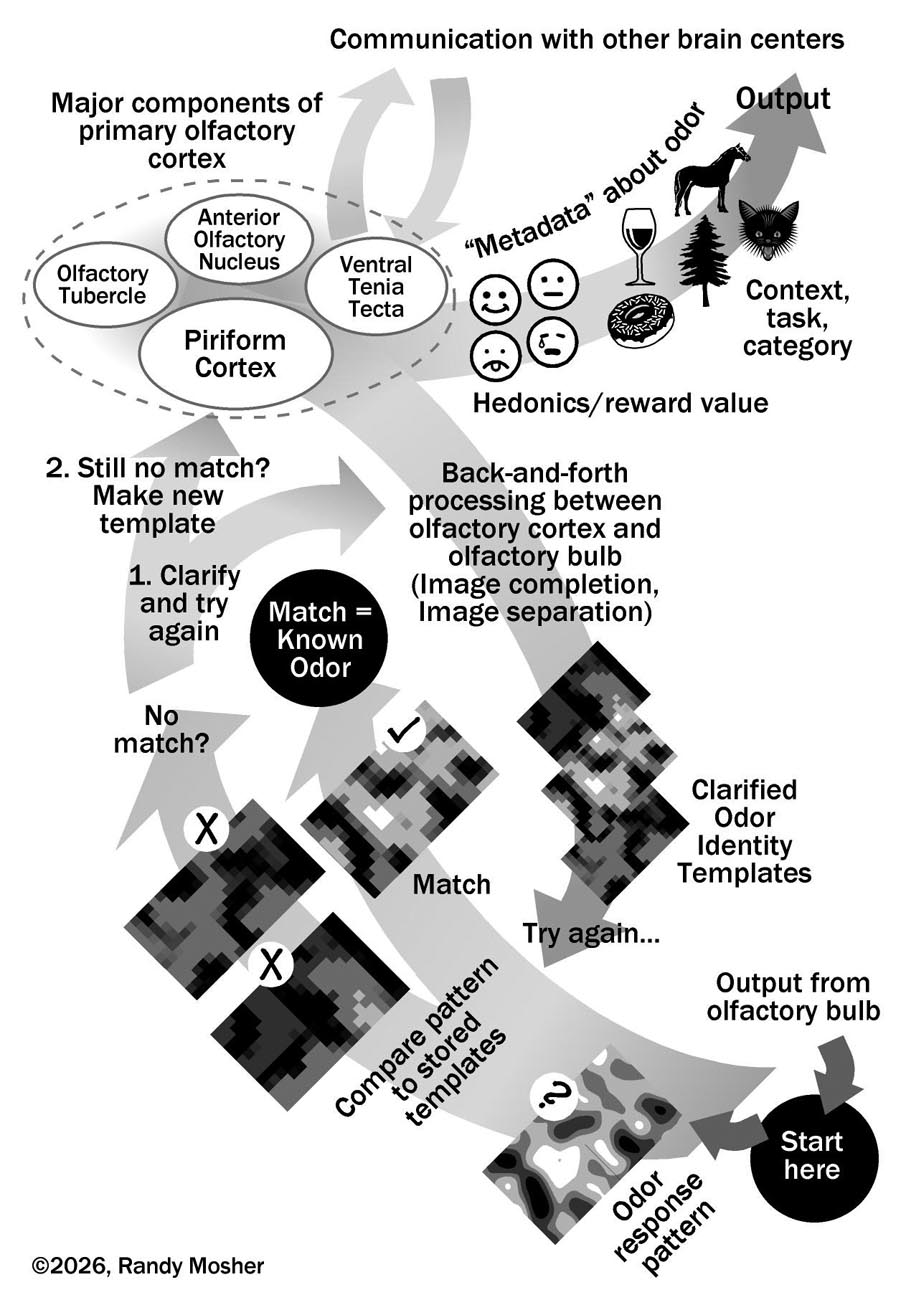
How it does this is too complex to cram into in a short blog post. My previous post details the basic image processing that turns faint and noisy biological signals into cleaner, sharper ones. While some basic image processing such as contrast enhancement and boundary sharpening occur entirely in the OB, it can only so so much. If the brain at first doesn’t recognize a pattern, it can do a little do-si-do with the primary olfactory cortex, completing patters with missing pieces and separating objects of interest from the background. With better patterns, the brain will hopefully recognize the odor, triggering those famous, haunting memories.
Once an odor is recognized, the brain has no further use for the complex receptor-odor interaction patterns, so this complex data never enters the brain; it’s just tossed out.
But somehow—and this is still a big mystery—our brain attaches a whole lot of metadata to the odor: context, value, identity and almost any other conceptual characteristic. In short, meaning that can drive action, motivation and planning.
This diagram is highly speculative on my part, made to help me understand how the olfactory bulb (OB) and olfactory cortex work together to clarify and recognize odor identity patterns, or templates. If there are computational neurobiologists out there with ideas for improving my diagram, I’d love to hear from them.
References:
RandyThomas A. Cleland and Ayon Borthakur, “A Systematic Framework for Olfactory Bulb Signal Transformations,” Frontiers in Computational Neuroscience 14 (2020), https://doi.org/10.3389/fncom.2020.579143.
Elena Kudryavitskaya, “Flexible Categorization in the Mouse Olfactory Bulb,” Current Biology 31, no. 8 (2021): 1616-1631.e4, https://doi.org/10.1016/j.cub.2021.01.063.
Thomas P. Eiting and Matt Wachowiak, “Differential Impacts of Repeated Sampling on Odor Representations by Genetically-Defined Mitral and Tufted Cell Subpopulations in the Mouse Olfactory Bulb,” Journal of Neuroscience 40, no. 32 (2020): 6177–88, https://doi.org/10.1523/jneurosci.0258-20.2020.
Shin Nagayama, “Neuronal Organization of Olfactory Bulb Circuits,” Frontiers in Neural Circuits 8 (2014), https://doi.org/10.3389/fncir.2014.00098.