
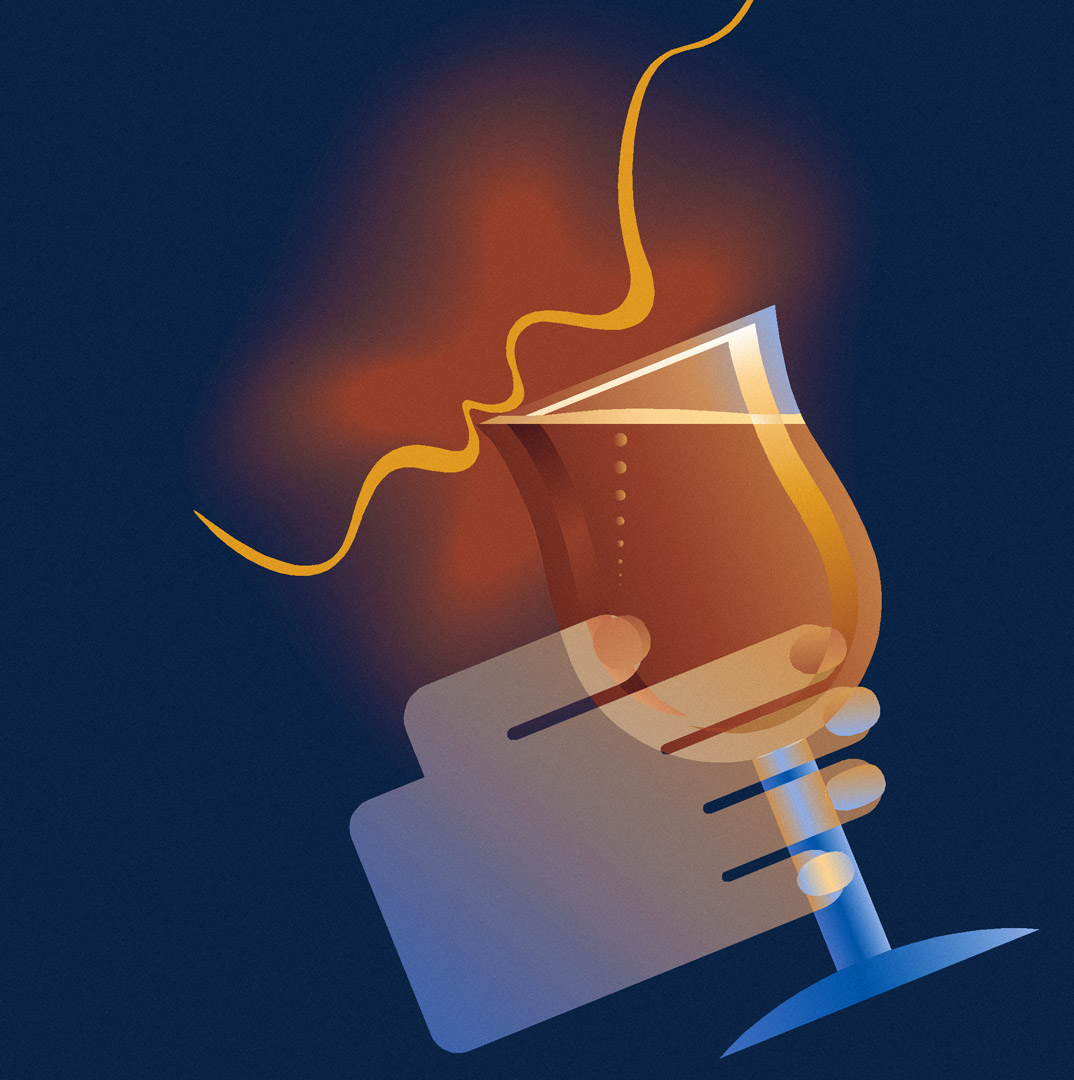
Watch an expert pick up a glass, give it a quick sniff and instantly the complexities of a wine or beer are translated into a few choice words. It looks like simplicity itself, but try to do the same thing as a novice and it’s often an epic struggle. Experts may make it look easy, but it takes a long time to get there. There are many barriers, not the least of which is that tasting is a deeply unnatural act.
Instead, what usually happens? Our sense of smell might toss a seemingly random memory into awareness, then suffuse it with a feeling of pleasantness (or its opposite) and tantalizingly illuminate tidbits of insight in and out of consciousness, like fireflies on a dark night. Frustratingly for most of us, the experience often leaves us grasping for the right words. The rise of language over the last million years or so occurred far too quickly for evolution to re-wire the odor-brain relationship. Our sense of smell happily does what we need in life, but as tasters, we need to re-train it to do what we want. And also train ourselves to listen to it more closely.
Billions of years of evolution have resulted in human sensory instruments of great power and subtlety, but dispassionate tasting was never in the design brief. Tasting asks our sensory system to turn chemistry into information, but it’s a struggle. Our request is a challenge: detectable odors, sorted by relevance and tagged with verbal descriptors, context and meaning.
How do we do this? First, use the clues our sense of smell gives us. Sure, they’re weirdly emotional and often seem like random flashbacks, but there is information there. These signals can be subtle, but don’t ignore them; they always contain a kernel of truth. Don’t throw up barriers in the form of strong expectations that can overshadow what our inner taster is trying to tell us. Sometimes you get a mental image; occasionally you’re possessed by an urge to just blurt something out. Follow the clues and never censor yourself.
The context and meaning part comes with experience. Humans are master categorizers. This cognitive process creates semantic structures that create frameworks for our sensations. In wine, they’re based on grape varietals and trueness to “type.” In beer, it’s mainly about styles. For those who actually make the products, it’s often about ingredients and process.
Language and semantics are not the only problems. Because of the way smells are coded into the brain, subcomponents of an odor merge together almost completely, a phenomenon scientists call configural perception. Since the complex patterns of receptor responses to chemicals are not retained in the brain, teasing apart the odors that make up a wine, beer or even the weirdly diverse odors that meld to form a strawberry odor can be very challenging if you haven’t been trained to do so.
A related problem makes identification challenging. Unlike other senses, odors undergo minimal neural processing before the raw data is dumped into our limbic system. This gives smells an “all or nothing” kind of wholeness, lacking the kind of primal subcomponents—lines, planes, etc.—we find in vision. Without being able to deconstruct, we are often stuck with a vague sense of familiarity, without being able to put a name to an odor, as scientists call it, the “tip of the nose” phenomenon.
Other issues are caused by our brain being a little too helpful. While sensory information starts with separate chemical senses, almost as soon as these streams enter our brain, they start to flow together into a multisensory experience that we generally experience as “flavor.” Since we’re trying to extract information, pulling this supersense apart into its components is necessary, but not easy.
As an example, if you think “sweet” just by smelling something, think again. It’s just not possible. Perhaps it’s just fruity or maybe you’re getting a whiff of vanilla, either of which we’ve learned to strongly associate with sweetness. The good news is that since much of the tasting process is cognitive in nature, it’s learnable. Time and effort expended definitely lead to better tasting abilities.
The flip side of this is that we can just as easily learn unhelpful things, developing biases that affect our judgment based not on what we sense, but what we think. Our conclusions can be affected by an endless list of these: expectation, verbal framing, habituation, sample order, psychological persuasion and even our own sense of how capable—or not—we are at this. A lot of the work in professional sensory evaluation seeks to minimize these effects. It’s also easy to let price, brand, ratings, rarity and other factors interfere with an honest assessment. This is why much of critical tasting and judging is done blind.
Finally, look in the mirror. Each of us is unique in our makeup. The genetic complexities of taste, and especially smell, means each of us brings different sensitivities to the tasting table. Blindness to certain chemicals important in tasting aren’t particularly rare, and neither are heightened sensitivities. We just need to understand them. Additionally, our abilities change with the trajectories of our lifetimes, ebbing and flowing with shorter cycles like circadian rhythms, too. Many aspects of our psychology, physiological state and even our medications can affect our abilities.
Tasting is not really impossible; it’s just really hard. To do it well requires plenty of discipline and experience, as well as a kind of openness and curiosity, which is why, despite the challenges, it can be a highly rewarding, self-altering endeavor.