
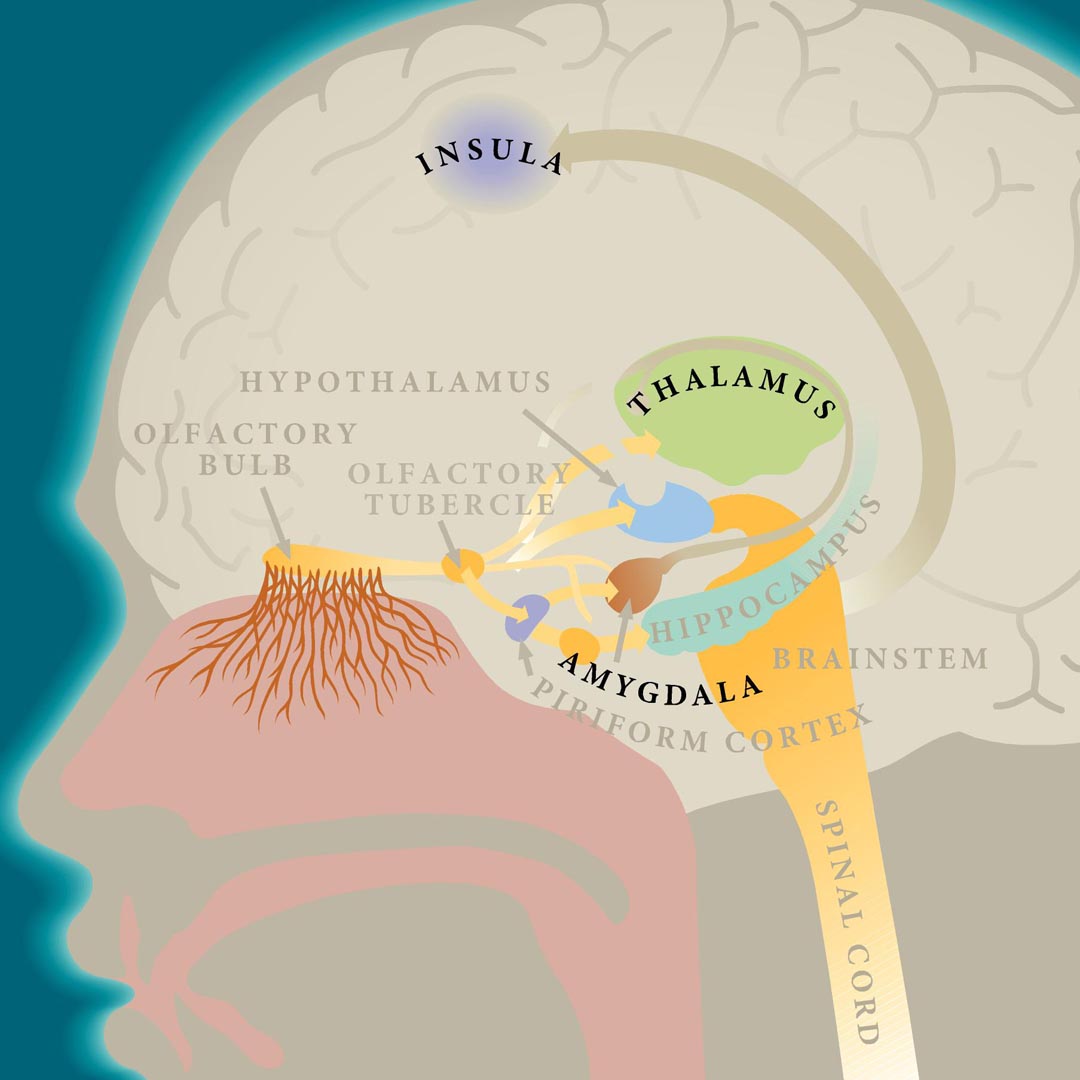
As soon as I started this massive project to answer every question I had about tasting, it became obvious that many parts of the brain—maybe most of it—were involved. The university graphic design program I attended didn’t have any required classes about neuroscience—although between you and me, it might have been better if it did. I had only the fuzziest picture of what the dozens of regions were doing and how they worked together. Let alone what their roles are in the chemical senses.
Obviously, I’m still no kind of neuroscientist, but I know enough now to be absolutely gobsmacked by the brain’s complexity, subtlety and extraordinary capability. Smell, taste and mouthfeel signals reach all the way up to the brain’s cognitive regions, although they’re combined into something more like flavor shortly after they enter the brain.
Recently reviewing some of the bits and pieces of text we cut because they were just a bit too detailed for what we were trying to do, I marveled again about all this neurological clockwork. There’s an awful lot more going on, but I think the capabilities, concerns and mechanisms of these brain regions I have plenty to say in the upcoming book, but these tidbits really needed to find a home, so here they are.
The Insula
The insula is very, very busy. As part of an ancient brain region called the paleocortex, it’s involved with attention, awareness, cognitive choices, expectations, subjective feelings, self-image and trustworthiness decisions, as well as music and the perception of time. The insula is like a whole party in your brain.
It’s also the first step on the integration of multiple senses. Its extensive network also includes vision and hearing, making it what scientists call ‘multimodal.’
The insula is not just a general center for sensory processing, but also functions as the primary taste cortex. If a particular taste pops into awareness shortly after you put it in your mouth, your insula may well be responsible. It’s the center of taste learning, also exchanging emotional information with the amygdala—good, bad or neutral.
The insula also receives mouthfeel sensations like texture, viscosity and heat—chemical or physical. While generally not seen as an important olfactory region, the insula manages to calculate the of pleasantness/unpleasantness of odors.
Taste identity and intensity are literally mapped in the insula. In rodents, the maps tend to be similar between individuals, each taste in a discrete area, organized taste-by-taste [[Ref: Chen et al., 2011]]. In humans, there does not seem to be a consistent organizing pattern, and so our own cortical map has been hard to even identify until recently. Tastes are represented, but are intermingled, and maps differ not just between people, but moment-to-moment, with complex patterns that are not well understood.
In one recent functional magnetic resonance imaging study (fMRI), where brain activity is highlighted by enhanced blood flow, each taste had different, non-overlapping regions for low and high concentrations. It’s unclear at this point whether that’s purely based on intensity or whether it points to separation by palatability vs. attractiveness. So it looks like some kind of a map, but is it helpful to us tasters? It’s probably hard to say until we know more.
The Amygdala
This includes the central amygdala, several regions within the hypothalamus and some other limbic regions. The amygdala is a limbic emotional center responsible for processing negative emotions and relevant threats, and also helps establish hedonic value and reward, resulting in experience-based palatability decisions about food. It’s kind of a dark place.
neuroscience, cognitive, neurological, primary taste cortex, pleasantness, unpleasantness, odor, cortical map, functional magnetic resonance imaging, hedonic value, operculum, ventroposteromedial nucleus, VPMpc, chemosensory processing, perception
The Thalamus
This small, pecan-sized brain region sits dead center our skull. It’s a vital brain network hub—perhaps the main one. With the adjacent operculum and insula, the thalamus is at the center of a complex network that connects cognitive brain regions with limbic ones. It is organized three-dimensionally, which is believed to aid in its role as a kind of “blackboard” for cognitive calculations involving actions and activities. It is sometimes referred to as the seat of consciousness; without a working thalamus, we do pass into unconsciousness.
The thalamus is an important sensory hub, too. All sensory signals but olfaction feed into it, but odor perception lacks the kind of temporal and spatial precision the thalamus demands. This lack of thalamic connectivity with olfaction means olfactory signals are mainly processed in our ancient limbic regions, explaining some of the smell’s weirdly emotional character, especially compared to our other senses.
A thalamic region called the ventroposteromedial nucleus (VPMpc) receives taste signals, encodes chemical identity and tactile sensations like texture and temperature. Another region (the mediodorsal), receives chemosensory information from higher in the brain, enabling it to integrate taste, smell and experience in ways that drive behavior, especially with regard to to novelty and familiarity. In addition to the thalamus’ cognitive connections, it also exchanges information with the amygdala—a region associated with like and dislike.\
Of course this is the briefest possible overview of just a few of the many brain regions involved in chemosensory processing and perception. Although knowing this has limited consequences for most of us, I find it incredibly interesting how our brains divvy up the tasks and flow of information to ensure efficient and accurate perception as well as action. This complexity is living proof that human sensory perception has been shaped by half a billion years of evolution to be exactly we need—no more, and no less.
References:
Redinbaugh et al., “Thalamus Modulates Consciousness via Layer-Specific Control of Cortex,” Neuron 106, No. 1, (2020): 66-75.e12, https://doi.org/10.1016/j.neuron.2020.01.005.
Worden et al, “The Thalamus as a Blackboard for Perception and Planning,” Frontiers in Behavioral Neuroscience, 01 March (2021), https://doi.org/10.3389/fnbeh.2021.633872.
Fontana and Maffei, “Synaptic Integration of Thalamic and Limbic Inputs in Rodent Gustatory Cortex,” eNeuro 7, No. 1), 0199 (2019), https://doi.org/10.1523/ENEURO.0199-19.2019.
Dionisio et al., “Connectivity of the human insula: A cortico-cortical evoked potential (CCEP) study,” Cortex 120, November (2019): 419-442, https://doi.org/10.1016/j.cortex.2019.05.019.
Koeppel et al., “Interoceptive accuracy and its impact on neuronal responses to olfactory stimulation in the insular cortex,” Human Brain Mapping 41, No. 11 (2020): 2898-2908, https://doi.org/10.1002/hbm.24985.
Kayyal et al., “Activity of Insula to Basolateral Amygdala Projecting Neurons is Necessary and Sufficient for Taste Valence Representation,” Journal of Neuroscience 39, No. 47 (2019): 9369-9382, https://doi.org/10.1523/JNEUROSCI.0752-19.2019.
Samuelson et al., “Effects of cue-triggered expectation on cortical processing of taste,” Neuron 74, No. 2 (2012): 410–422, https://doi.org/10.1016/j.neuron.2012.02.031.
Odor descriptions are from GoodScentsCompany.com
Note: I have talked to a couple of malt chemists to see if anyone had the information to essentially add another column to this chart: specific malt types displaying characters of the chemicals listed here, but came up empty. I could guess, but know there must be solid science out there somewhere. If anyone has a lead on this, drop me a line and let’s talk.
References for the chart:
Gary Reineccius, Flavor Chemistry and Technology, 2nd Ed. (CRC Press, 2005). ISBN-13: 978-1566769334
Stefan Coghe, “Effect of non-enzymatic browning on flavour, colour and antioxidative activity of dark specialty malts—A review,” Monatsschrift fur Brauwissenschaft 57 (2004): 25–38.
David J. Rowe, Chemistry and Technology of Flavors and Fragrances (Wiley Blackwell, 2004). ISBN-10: 9781405114509
Jiyoon Cha, T. Debnath, & KG Lee, “Analysis of α-dicarbonyl compounds and volatiles formed in Maillard reaction model systems.” Scientific Reports 9, (2019): 5325, https://doi.org/10.1038/s41598-019-41824-8
Raphael Prado, “Aroma and color development during the production of specialty malts: A review,” Comprehensive Reviews In Food Science And Food Safety 20, no. 5 (2021): 4816-4840, https://doi.org/10.1111/1541-4337.12806.
Caroline Scholtes et al., “Guaiacol and 4-Methylphenol as Specific Markers of Torrefied Malts. Fate of Volatile Phenols in Special Beers through Aging,” Journal of Agricultural and Food Chemistry 62, No. 39 (2014): 9522–9528, https://doi.org/10.1021/jf5015654