
Beer is an extraordinarily fragile beverage. It is composed of well over a thousand chemical components coexisting in an uneasy and short-lived balance, far from anything resembling chemical equilibrium. It’s best within weeks of its packaging day, a fact that few of its fans really realize. No matter; at some point staleness can no longer be ignored, as cardboardy, leathery and unpleasantly sweetish characters get right up in the drinker’s face. This is such a problem for the whole beer industry that it has spent more time and money on this problem than any other technical issue.
It’s not one thing that goes wrong. Everything goes wrong. In beer’s dynamic environment, pleasant-smelling chemicals get transformed into less appealing ones and bitterness fades. Oxygen sneaks in at various points in the brewing process and silently waits to unleash a destructive wave of chemical modification that not only has its own dull and cardboardish odors, but can be brilliantly subversive at masking positive characteristics as well. Even beer’s body and foamy head are subject to these ravages, as its protein structure falls apart, which you may have noted as a snowglobe effect in some dusty bottles of slow-selling Euro-beers. Careful brewing can slow these disappointments, but not stop them.
I’m not complaining. I view beer’s vulnerability as one of its aesthetic charms, one that actually draws us closer to its source. Beer is not to be invested in or secreted away for some future reward. It’s to be enjoyed. Now. Beer reminds us, that like our own selves, everything has a shelf life.
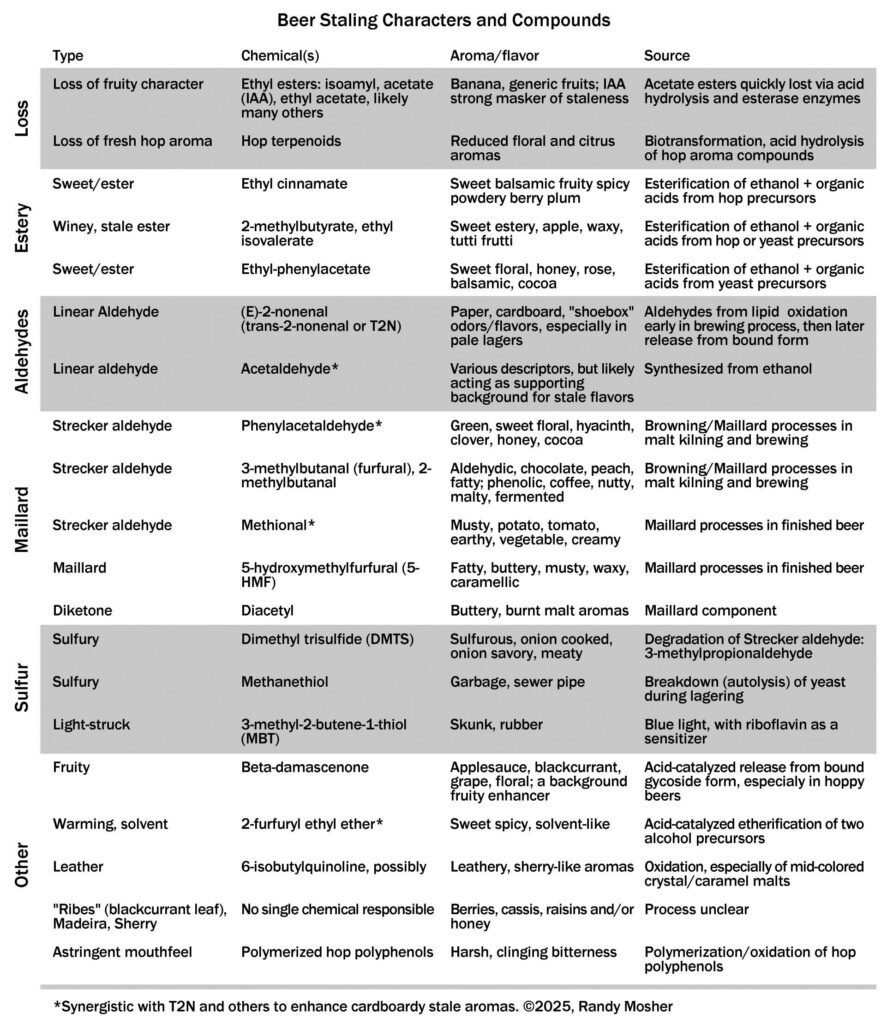
There is far more than I can discuss in a brief blog post here, but this list—as comprehensive as I could make it based on current research—should offer you a fascinating checklist to review when you suspect a beer may be starting to decline.
References:
TheGoodScentsCompany.com (some aroma descriptors)
Greg Casey, “Understanding & Controlling Flavor Stability in Beer: The Good, the Bad & the Ugly,” American Society of Brewing Chemists, RMMS, Colorado Springs, Feb 24, 2006.
Tuur Mertens, “Transition metals in brewing and their role in wort and beer oxidative stability: a review,” Journal of the Institute of Brewing 128, no. 3 (2022), https://doi.org/10.1002/jib.699.
Bart Vanderhaegen, “Evolution of Chemical and Sensory Properties during Aging of Top-Fermented Beer,” Journal of Agricultural and Food Chemistry , 51, no. 23 (2003): 6782–90, https://doi.org/10.1021/jf034631z.
Daan Saison, “Contribution of staling compounds to the aged flavour of lager beer by studying their flavour thresholds,” Food Chemistry 114, no. 4 (2009): 1206-15, https://doi.org/10.1016/j.foodchem.2008.10.078.
Laurence Gijs et al., “3-Methylthiopropionaldehyde as Precursor of Dimethyl Trisulfide in Aged Beers,” Journal of Agricultural and Food Chemistry 48, 12 (2000): 6196–6199. https://doi.org/10.1021/jf0007380.