
I met Robin Goldstein by chance at a Craft Beer Conference years ago, and thought he had really interesting things to say about sensory as well as the sociology of the world of wine. Robin is an economist who at the time, was Principal Economic Counselor at the University of California Agricultural Issues Center, but later moved on to cannabis economics. His (along with co-author Alexis Herschkowitsch) book, The Wine Trials, is a practical guide as well as a fascinating look at what different groups value in wine. This interview was conducted in November of 2019.
RM: Can you tell me what you’re up to these days?
“I finished my PhD in Economics recently. I went back to the heart of the original study of wine snobs, studying price and other properties of wine and expanded it to several categories. My thesis is called “The Bullshit Horizon,” and it covers wines, beers and restaurants. After I set up a prank on Wine Spectator in which they bestowed an Award of Excellence for a wine list at a nonexistent restaurant (web site and phone only) that featured the Spectator’s worst-rated wines, I was interested in these kinds of awards and their impact on the prices that could be charged.
Since there seemed to be a lot of them, these awards are what economists call “non-rationed goods.” The entry fee to be considered for a Wine Spectator Award of Excellence is $250, and as the example of the fake restaurant shows, they hand them out pretty freely, as in “non-rationed.” We wanted to know how good an investment that is. We looked at Zagat as far as pricing and looked for correlation. W-S awarded restaurants had higher food prices, but there was actually a negative correlation between price and ratings at a certain price categories.”
You became pretty well known with a book called The Wine Trials, in which various wines were blind tasted by different groups, from expert to rank amateur, and the results bore little resemblance to price.
“I’ve got another study coming out in the Journal of Wine Economists. We did a “half-blind” tasting. We took two identical bottles of white wine, and put one in a brown bag, and left the other one with its label and also a price sticker showing. We tested the same wine at two purported price levels: $5 and $50. When we asked people to rate the wine, the low-price wine was rated lower than the brown-bag (nobody noticed they were the same), while the $50 wine was rated as higher than the anonymous one.
I was a wine and food critic and writer before the Wine Trials (Book: The Wine Trials, a cross-country experiment in blind wine tastings), and was trained as a sommelier. I really felt I was not a snob or a bullshit artist. But after the trials, it became apparent to me that there was absolutely no relationship between wine price and drinker preference, except maybe that most people preferred inexpensive wines to expensive ones.
So I had to admit to myself that I was one of the people who was full of shit. Wine “experts” are not in that role because they have more discriminating tastes. There aren’t even any theoretical objective standards for what wine is supposed to taste like, so the job is not to describe objective physical reality. You end up with guys in their blazers talking about white peaches. It’s actually very unfashionable to talk about anything that is not imaginary. It’s a whole imaginary system, kind of a group hallucination. Everybody goes along with it. Wine ratings are especially full of shit because there isn’t even an attempt to state any objective standards.
I’m trying to change my ways. I don’t drink much wine anymore. I solved the problem by mostly switching to beer, although I still do have a taste for expensive old Burgundies. But beer, mostly, is described in much more physical terms without the bullshit, although it does seem to me that some parts of the beer world are starting to feel similar to wine, with the high prices, rarity, collecting and all that.”
Yes, there is some madness creeping in at the red-hot center.
“Unfortunately, I feel that craft beer snobbery is now on the rise, with people talking about kumquats in their IPA. But at least in the case of beer, the IPA might actually be brewed with kumquats. In wine, it would be illegal for the wine critics’ flavors to actually be in the wine.”
And those wine reviews and ratings?
“Despite the fact that most people prefer inexpensive wines, there’s no such thing as a $10 wine that scores 100 points. It just can’t be allowed to happen. The connection of price to quality is something so fundamental, people have a hard time believing it’s not true. And in the business, it’s in few peoples’ self-interest to expose. The “experts” propagate imaginary information about wine to support a larger theory that more expensive wines taste better.”
Wine reviews seem to be pretty optimistic, without much mention of problems.
“In fact, there’s a real lack of ability or willingness to detect defects.”
Like malolactic (fermentation to speed up maturation that can add a buttery flavor).
I really don’t like those malolactic flavors, but it turns out that buttery notes are pleasing to the majority of drinkers, who have a different set of tastes. I also think most California wine has too much vanilla, oaky flavor, but most people love those, too.”
I’m with you.
They don’t notice or don’t care—they’re not tuned in to flaws, just to new and fashionable properties. Some of it is this constant churn of fashionable flavors. For a long time, big buttery California chardonnays were the thing. Now it’s Grüner Veltliner, even though it’s quite acidic; for most people it’s an acquired taste. But people will acquire a taste for it, and then that one will be rejected by the experts. Again.
Taste in wine is a lot like taste in music: it’s kind of random. In a way, the bullshit is the fun of it, this whole thing we create in our imaginations. We share this with friends, have some ceremonies around it. Studying all of this, I’ve come to the point where it’s best to not beat ourselves up too much and just appreciate what is motivating to people, knowing where the pleasure comes from.”
Do winemakers evaluate wine any more dispassionately than ‘experts’?
“Winemakers are not full of shit. Actually they are usually super-annoyed by critics, and generally that relationship is not one of mutual respect. The winemakers job is to tailor the wines to be pleasing to the maximum number of their customers.”
Why do you think some people are ‘red wine only’ drinkers?
“Maybe it’s because red wines are processed less. You know, they have to take off the skins and stems—and there’s more in the skins besides color. It might also be that wine taste better at room temperature rather than cold. There is more aroma that way. White wine is also almost certain to be filtered, and that takes some of the flavor and texture out—red wine less so.”
I know you’re interested in wine and class, and to me that’s one of the more troubling aspects of it.
“It used to be low-class to drink wine in American before the 1960s, and about then, things started to change. But there’s all this status and class associated with wine.”
We can blame the ancient Greeks for that, since they defined “barbarian” as someone who drinks beer.
“It goes back so far. I guess the Romans set up a whole classification system at different prices and levels of “quality.” So we have norms around class and group identity we adopt and sometimes abuse, sometimes willfully, sometimes only semi consciously.”
How do you teach people to taste wine?
“My first job is to help people learn to discriminate. So I do a triangle test with a merlot and a Cabernet, or maybe a French red and a California. There are three glasses. Two of them are the same, and the other is different. The task is to just tell the difference. Once they can do that, then I give them four wines, and they can take their time evaluating, making notes.
Some time later, I present them with the same wines, and they have to match them up with their notes. If you can’t do that, then you can’t graduate to the next step, in which I ramp up the difficulty. You need your notes to contain actual information. If you don’t have content in your notes, it’s hard to have consistent preferences.
Don’t use wine words you’ve heard. Use your own words. Don’t worry about trying to get it right.”
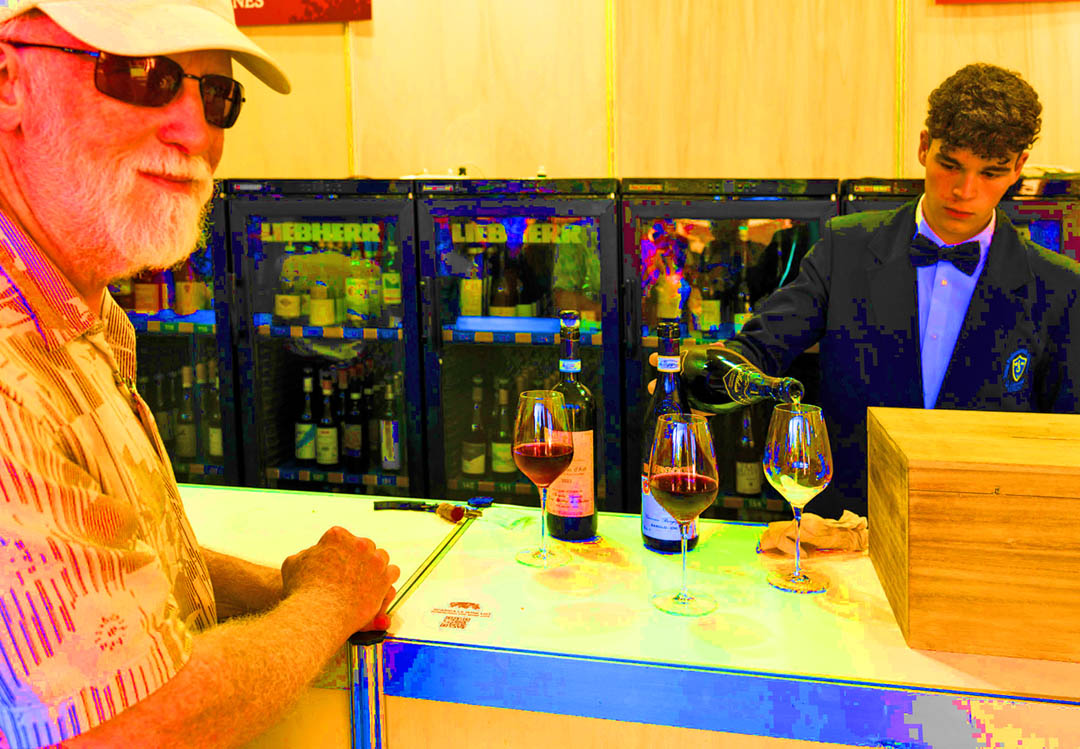
Image, above: Me, at the 2024 Slow Food Salone del Gusto, in Torino, Italy, waiting for half pours of Grignolino d’Asti, Barolo and Something sparkly for Nancy. Photo by Jonathan Levi