treceptchart2-0

Trigeminal Wonders

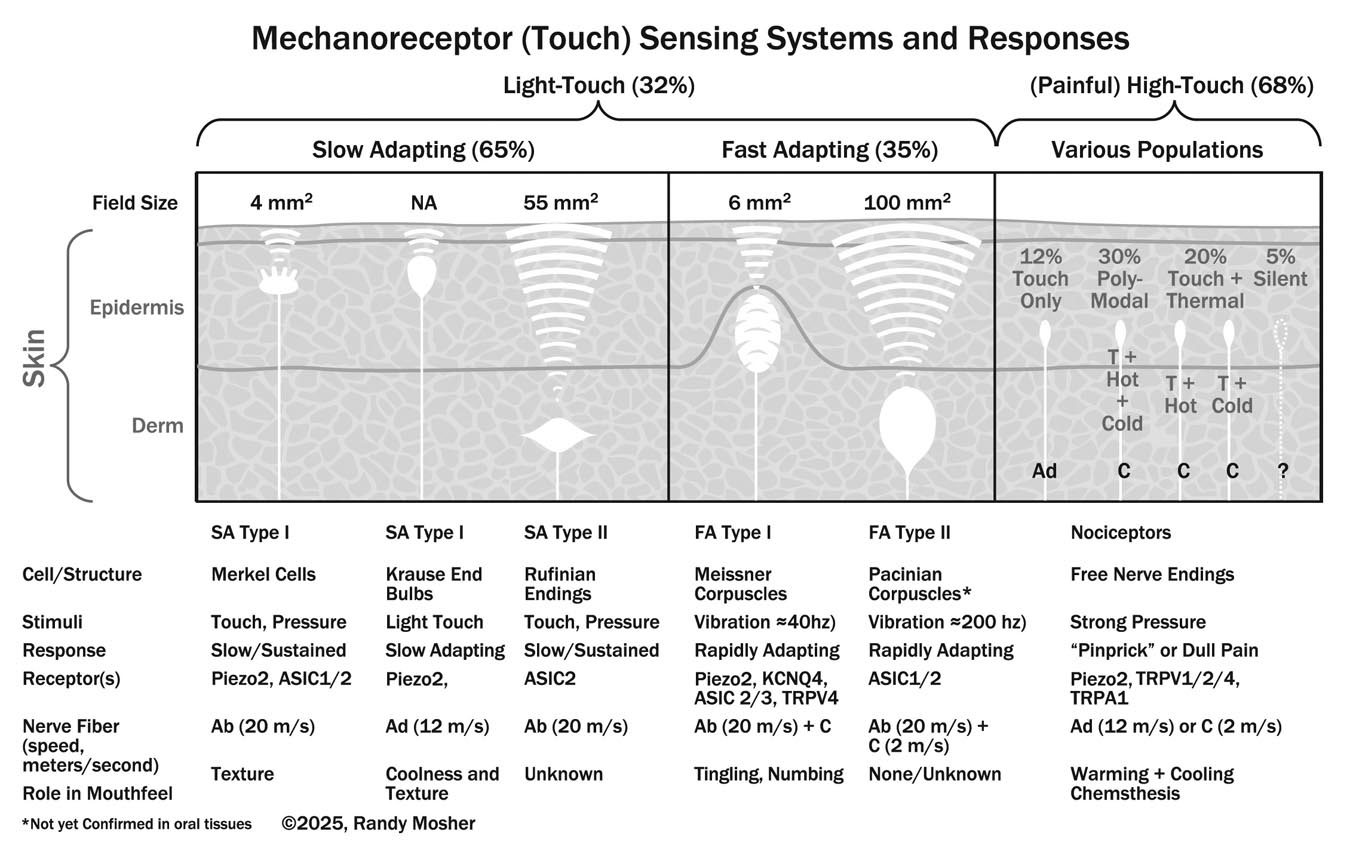
Our trigeminal system consists of multiple coordinated sensory inputs based on more than a dozen receptor types. As I often do to get a grip on a subject, I found it helpful to diagram various parts of it. As the book was getting longer and longer, we decided we could do without the diagram, so I’m presenting it here. It’s a representation of the major touch sensing systems we use for mouthfeel/trigeminal sensations.


or-trans2-2mr

Every Odor’s Starting Point: A Biochemical Pinball Machine

If you know even a little about the olfactory system, you get the general idea that at the very beginning of any perceptible smell are numerous events in which odorous molecules bind to receptor proteins. This ultimately results in a neural signal being transmitted into the brain via the olfactory bulb. This was my starting point, too, but I decided it would be interesting to know how all that actually happened.

hddnsens bod1-0mr

Hidden Taste Systems

Of our chemical senses, taste is the one most of is is probably the most obvious. A sweet, salty, sour or bitter taste on our tongue is quick and unambiguous, although umami and others can be more nuanced. The last thing we would expect is a parallel taste system in our bodies operating entirely behind the scenes.

licia09beercafe1cmr

What’s Going On in the Olfactory Bulb?

Part One: Signal Processing

Unlike manufactured systems, our senses can’t rely on highly accurate and linear sensors to convert external stimuli into usable signals. Biological systems are inherently variable, noisy and limited in range, yet we need clear and accurate information to guide our behavior. How do we manage to do this?

Wine waiter woman during blind tasting various alcoholic beverages. Sommelier exam to study different wine and beer.

Develop Your Hop-Sense

It’s obvious that we human beings are all pretty different from one another—in appearance, experience, attitude, gender, and countless other attributes. Each of us has things that come effortlessly and others at which we struggle. It goes without saying that these differences affect our abilities as tasters. But how, exactly?

Unrecognizable woman drinking beer on a restaurant with views to nature

Mouthfeel: Beer’s Stealthy Charm

Every beer taster can recognize the bitter snap of hops on the palate, the caramel-to-roasty spectrum of malt aromas, and occasionally the spicy, fruity signatures of certain yeast strains. We love beer’s boldness, and in recent years the volume has definitely been turned up. Amid all the hubbub it’s easy to overlook one of its most unique charms: mouthfeel.