
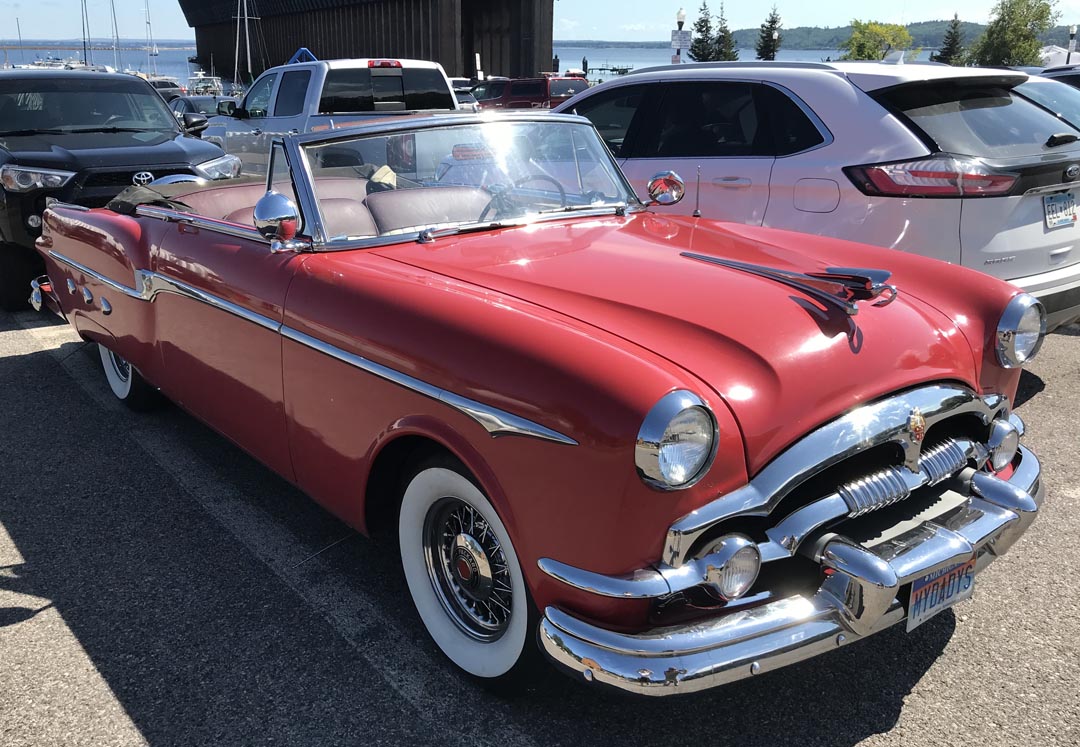
This is a story about how even a toxic stew of dangerous chemicals can come to be perceived as something not just pleasing, but emotionally compelling. Back in the heyday of American automotive glory, most vehicles were affordable but they rarely lasted very long. For most middle-class families it was normal to buy a new car every two or three years. This meant trading the rust, dragging mufflers and stale design for something shiny and fresh. The sweetly intoxicating odor of vinyl chloride, a component of the soft plastic that covered much of the interior was the primary odor note that I recall, and it was the olfactory touchstone for this rebirth. It was (cough, cough) glorious.
Of all the microenvironments in which most of us spend our time, from homes to offices to pubs and shops, cars have hands-down the highest concentration of volatile organic compounds (VOCs). Over the years, concerns about the toxicity of volatile organic chemicals has led to their reduction as much as possible.
For the most part, classic new car smell is composed of hydrocarbons: solvents, plasticizers, glues, coatings, polymer building blocks called monomers and others. Most of these have short-term effects on us, including respiratory problems: eye, throat and/or skin irritation, drowsiness, fatigue, headache, dizziness and nausea. Many of these chemicals also have long-term exposure issues including the risk of cancer. Many of the more dangerous ones have been restricted or outright banned for this use.
Most of these chemicals enter the cabin via off-gassing, as volatiles are released over time from their plastic substrates. Release is temperature-dependent. On a hot sunny day the temperature inside a vehicle can be 150°F (66 °C) or more—even higher on the dashboard—increasing the release of VOCs by an order of magnitude or more over room temperatures. A typical car interior has at least eight different types of plastic: a single one can emit a dozen or more chemicals. And don’t forget there’s rubber, leather, foams, fabrics and their finishes, and many others.
And the incomparable allure of vinyl? It’s actually a mix of the following:
• methyl ethyl ketone: acetone ethereal fruity camphoreous
• ethyl acetate: ethereal fruity sweet weedy green
• toluene, the solventy smell of the plastic model cement of my childhood
• butyl acetate: ethereal solvent fruity banana
• cyclohexanone: minty acetone
• 4-isopropyl phenol: woody warm spicy medicinal
Despite the looming danger, the smell of a new car remains a potent attractant to Americans, and has been shown to create emotional responses in potential buyers and owners. Companies like Nissan, Fiat-Chrysler and others hire materials engineers to curate cabin odors within allowable limits to ensure appeal. If your older vehicle has lost its new car smell, there are countless cleaning sprays and air fresheners that promise to replenish it. Of course, all of this is culturally linked. For buyers in China, the best new car smell is no smell at all. Asian countries, especially China and Korea, have very low allowable limits of VOCs
References:
Faber and Brodzik, “Air quality inside passenger cars,” AIMS Environmental Science 4, No. 1 (2017): 112-133, https://doi.org/10.3934/environsci.2017.1.112.
de Souza and Nascimento, “VOCs evaporation rate from a poly(vinyl chloride) matrix and its impact over interior’s atmospheric composition,” SAE Technical Paper 2010-36-0230 (2010), https://doi.org/10.4271/2010-36-0230.
Pooniagpoonia, “The truth behind the ‘new car smell,” Deseret News, Apr 18, (2022), https://www.deseret.com/2022/4/18/23030575/new-car-smell-nissan-professional-sniff-testers.
Kurczewski, “The Science of the New-Car Smell,” Car & Driver, July 10 (2021).classic