

Our minds work hard to parse every sensory impulse into psychological qualities that help us respond appropriately. Among the most important is determining the value of the sensation and the object it represents.
Value has several defined characteristics. First, it rises and falls with the baseline state of the organism, so any valuation rides on top of how we’re feeling about life. This means value can be modulated by changes in our state by any mechanism. Second, the valuation system uses a “common neural currency” allows absolutely anything to be valued and compared. Third, this system works automatically in the background, without our input or conscious control. Finally, the output is not just a valuation; it includes a confidence score as well. Both the value and the confidence score drive our behavior.
Also, not every object being valued is immediately at hand, so time and distance are also factored into the calculation. This requires the participation of cognitive/executive centers in the prefrontal cortex. A sub-region called the ventral striatum calculates the predicted value of future rewards and the difference between an expected and experienced reward. These cognitive centers feed their calculations down to lower regions that sum up everything, assigning a value. A brain network called the mesocorticolimbic system brings all levels of the brain together to do this. It’s not at all clear how the system weighs and integrates such diverse inputs, or how it ultimately translates this into a universal valuation currency, but we do know a few things.
Separate brain regions appear to specialize in either negative or positive valuation. Positive values seem to organize around the medial orbitofrontal cortex (OfC), the ventral striatum and the insula, while negative ones involve another part of the OfC (the lateral), the insula and amygdala, as well as the nucleus accumbens (NAc). Signals from the gut also feed into this system, as do various hormonal signals reflecting the state of our bodies.
The NAc is an interesting piece of kit that lies at the very heart of valuation. Its structure has been described as an “affective keyboard,” with zones laid out like piano keys, each representing one level of either positive or negative valence. Not just that, but the NAC actually has two of these keyboards; one purely hedonic (liking/disliking) and another signaling motivation (wanting) or its opposite. Top-down signals from cognitive regions can strongly affect this motivation, but only the bottom-up signals from the lower brain can modulate the hedonic value, offering interesting clues as to which part of the brain contributes what things to this calculation.
Amazingly, we can determine a value for anything imaginable. Some of these calculations can be bogglingly complex. What, for example, is the real value of an expensive sports car like a Ferrari to me—assuming, unrealistically, that I actually could afford one? Well on the one hand, they’re beautiful, rare and probably a lot of fun in the right moment. But they’re also wasteful, ostentatious and will surely cause a host of headaches out in the real world. Does such a pricey car make me a crime target? And there are social factors, too. Is the value of the attention I’d receive positive or negative? Who would think I’m cool as opposed to just an arrogant showoff trying to compensate for something? Would I need to lose weight to squeeze into one of those douchey red leather jackets with the prancing horse logo on the back? Would my wife murder me in my sleep? This example is extreme, but people make these kinds of decisions all the time, and our brains are perfectly able, ready and willing to do the calculations and confidently act on them.
Making Decisions
For each contemplated action, our cognitive brain predicts an outcome based on likelihood, relying on a model of possible outcomes. The model is tweaked when results don’t match expectations. At the heart of the decision process are two competing groups of neurons in cognitive regions, accumulating evidence for different choices. When one or the other reaches a certain threshold, this triggers the choice.
While our decisions can be highly strategic, many other factors can affect expectations and experiences of value. These often include a strong emotional component, especially when involving social costs/benefits, dietary choices, self-control and addictive behavior. Even expected efficacy has been shown to increase the perceived performance of a pain-reduction therapy, which would seem to be evidence of a placebo effect.
Neuroeconomics
A discipline called neuroeconomics seeks to understand how the brain makes decisions, then use those insights to make economic analyses and actions. It’s challenging. Even if you can work out the neural processes, they’re hard to simplify down to something a marketing director might act on, and Also, at the core of many economic principles is that we are “rational actors” who always make the most beneficial choices for ourselves and those around us, but it’s demonstrably untrue.
Motivated behavior involves emotion, making predicting human behavior crazy hard. That’s why the discipline ofneuroeconomics uses physiological measurements, not self-reported intentions or evaluations, which are notoriously dodgy. Emotional response intensity is a good predictor of consumer choices, especially when driven by brand equity and loyalty. In one study, subjects were presented with brand, label and country of origin, and finally taste. In the brand identity phase, willingness to purchase in a staged auction was strongly predicted by pupil dilation. Statements of liking were not very predictive of the choices actually made, as it was only weakly correlated with the neurometric measurements.
Another facial expression study looked at the effect of positive emotions (joy) and experience-based hedonic valence. While they found the two to be correlated, when presented with a wine, a credence attribute —organic farming, in this case—brought joy that translated into intent to purchase. This was more important than conventional hedonic attributes, leading the researchers to conclude that emotion is especially important for choices in goods with credence attributes.
So now you know a bunch of other ways in which you, like all of us, are deeply weird and barely under conscious control. While this strangeness may foil your plan to become the perfect tasting machine, this is the way our organism has evolved to best interact with the world. So, we just have to deal with it.
The Basics of the Brain’s Valuation and Reward Circuit
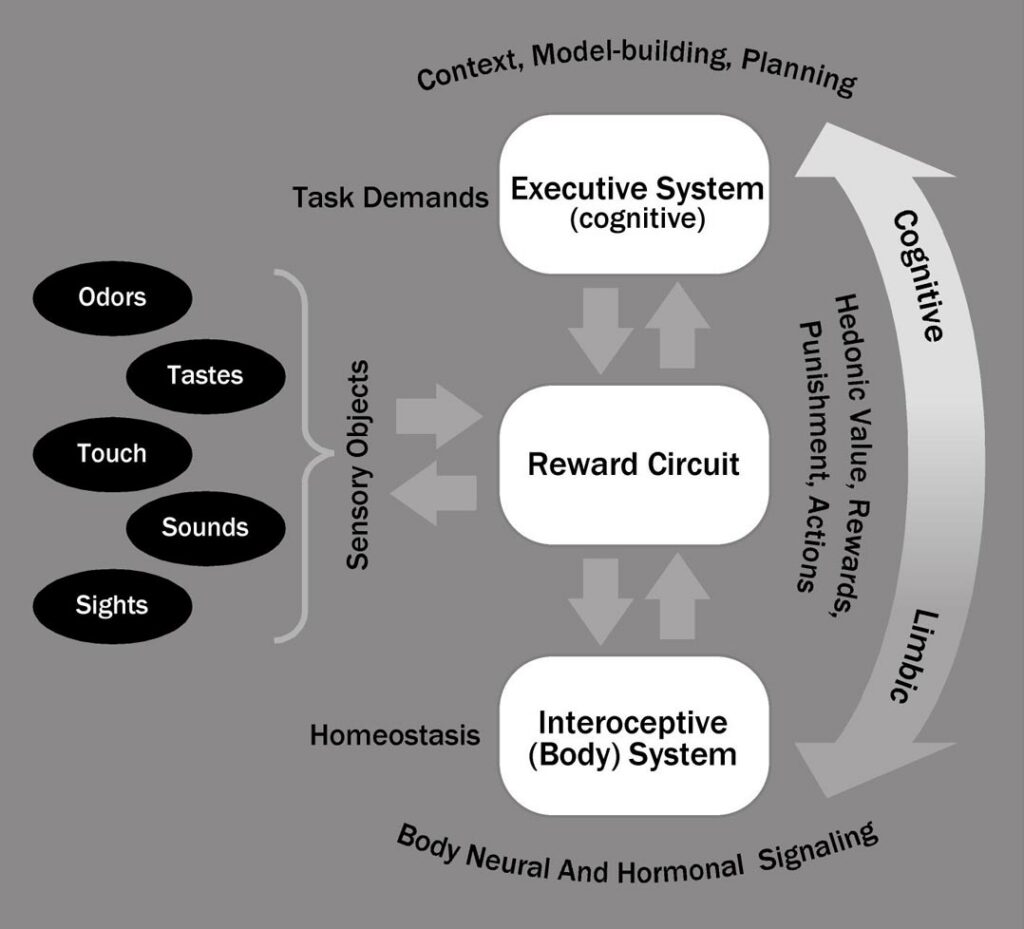
This shows the parts and pieces of the mesocorticolimbic system and the connections between them. At the top are cognitive regions responsible for executive functions like planning and maintaining our model of the world. The interoceptive system monitors the body’s metabolic and physiological state. In-between is the reward circuitry that determines value based on inputs from the senses and elsewhere in the brain and delivers rewards. Adapted from Skov, 2022.
References:
Alizée Lopez-Persem, “Four core properties of the human brain valuation system demonstrated in intracranial signals,” Nature Neuroscience 23, 13 April (2020): 664–675, https://doi.org/10.1038/s41593-020-0615-9.
Alexis Faure, “Desire and Dread from the Nucleus Accumbens: Cortical Glutamate and Subcortical GABA Differentially Generate Motivation and Hedonic Impact in the Rat, ” PLOS, June 18 (2010), https://doi.org/10.1371/journal.pone.0011223.g002.
Arkady Konovalov and Ian Krajbich “Over a Decade of Neuroeconomics: What Have We Learned?” Organizational Research Methods 22, No. 1 (2019): 148-173, https://doi.org/10.1177/1094428116644502.
Liane Schmidt, “How context alters value: The brain’s valuation and affective regulation system link price cues to experienced taste pleasantness,” Nature Scientific Reports 7, No. 8098 (2017), https://doi.org/10.1038/s41598-017-080800.
Laura Enax and Bernd Weber, “Marketing Placebo Effects – from Behavioral Effects to Behavior Change?” Journal of Agricultural & Food Industrial Organization 13, no. 1 (2015): 15–31, https://doi.org/10.1515/jafio-2015-0015.
Martin Skov, Chapter 7: The neurobiology of sensory valuation, 150–72, in The Oxford Handbook of Empirical Aesthetics, ed. Marcos Nadal and Oshin Vartanian (Oxford University Press, 2022). ISBN: 0198824351.
Myriam Caratù, Application of Neuro-Marketing Techniques to the Wine Tasting Experience, 11th Annual Conference of the EuroMed Academy of Business (2018): 290-298, ISBN: 978-9963-67-3.
Djamel Rahmani, “How Emotions Affect Choices: The Case of Wine,” The 31st International Conference of Agricultural Economists, August (2021), https://doi.org/10.22004/ag.econ.314943.