July 2026
I was invited to participate in the Copa Capitol Cervecera, a fairly typical combination of a competition, conference and festival over the course of a week. It’s called that because the brewers in Valdivia, a smallish city in Chile’s mid-south, consider themselves to be the capitol of craft beer in the country. Judging by the 140 or so breweries in the area and the number of awards they won in this competition, they have a decent claim to the title.
Valdivia (val-DEEV-ya) is about 400 miles south of Chile’s capitol, a couple hours north of where Patagonia really begins. The area is criss-crossed with rivers, with a temperate rainforest on the lower slopes of the stratovolcanoes and other mountains that form the cordillera—the massive mountain range that runs along the western edge of South America. The climate there is reminiscent of the US Pacific Northwest. When I’m there, it’s winter, with a lot of rain and occasional fast-melting snow, as the nearby Pacific Ocean moderates temperatures. It’s often foggy, a big problem for airlines, since the airport is undergoing modernization and lacks the kind or radar systems needed to land planes in the mist. My flight from Santiago was canceled after several hours of delays caused the crew to time out.
As the news of the flight was getting gloomier, a brewer named Daniel Moscoso who was heading to the same event, recognized me and saved the day. After getting re-booked for the next day and a hotel room for the night, we took off to meet some friends at a small brewpub called Cervecería Intrinsical in Santiago’s Divina Providencia neighborhood. Daniel brews at Bodega Ergo (under the same ownership) but it wasn’t open until later, but several of his beers were pouring at Intrinsical. He specializes in grape ales, incorporating the area’s fine varietals to make a range of unique and tasty beers.
Although beers incorporating grapes go back millennia, Italian craft brewers reinvented this style about twenty years ago. Grapes bring unique fruitiness and acidity to beer, and with red grapes, color and tannins too. Their abundant sugars lighten a beer’s body and make stronger versions dangerously drinkable. We tasted Mon Amie, a Brettanomyces-tinged farmhouse at 6% A/V, a well-balanced rosé (about 7%) and a purplish dark beer with Petit Verdot grapes. Most amazing was The Dark Side of the Chorito ( type of mussel), a 9% imperial stout brewed with local smoked mussels, surprisingly without a trace of fishiness.
But what about the food?
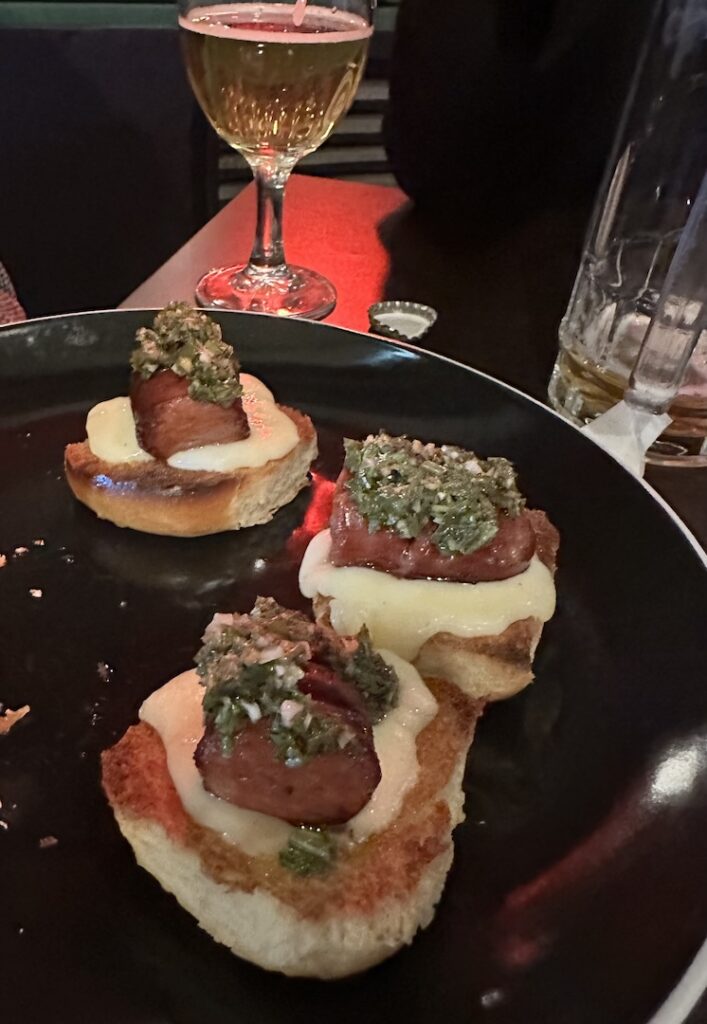
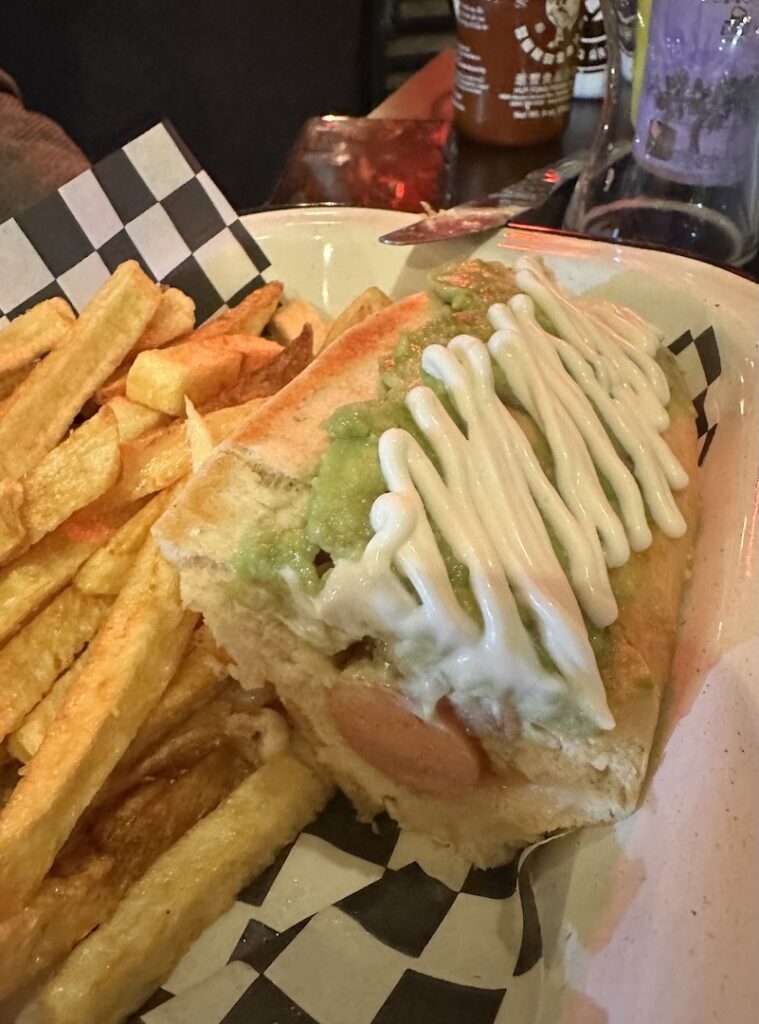
Needing a little something, we started with the most humble: a snack popular at “asada”-style barbecue feasts called “choripan,” a word combining “chorizo” (sausage) with“pan”(bread). The outdoor party version is just half a roll with an unadorned chunk of grilled chorizo in it—kind of like a spicy Kielbasa—more like Spanish than Mexican. Since this was a big city brewpub, these were more dressed-up: bite-sized, open-faced, with a small chunk of grilled chorizo and melted cheese on half a slider bun, topped with chimichurri, the parsley, vinegar, oil and garlic relish for meat popular across Southern South America. After that was a completo Italiano, a tricked out jumbo hot dog in a bun, with tomatoes and chimichurri, topped with mayonnaise, together bringing the colors of the Italian flag. With a smooth and smoky wiener, the whole mess really was quite tasty. A serious hot dog. Great beers, great little brewpub.
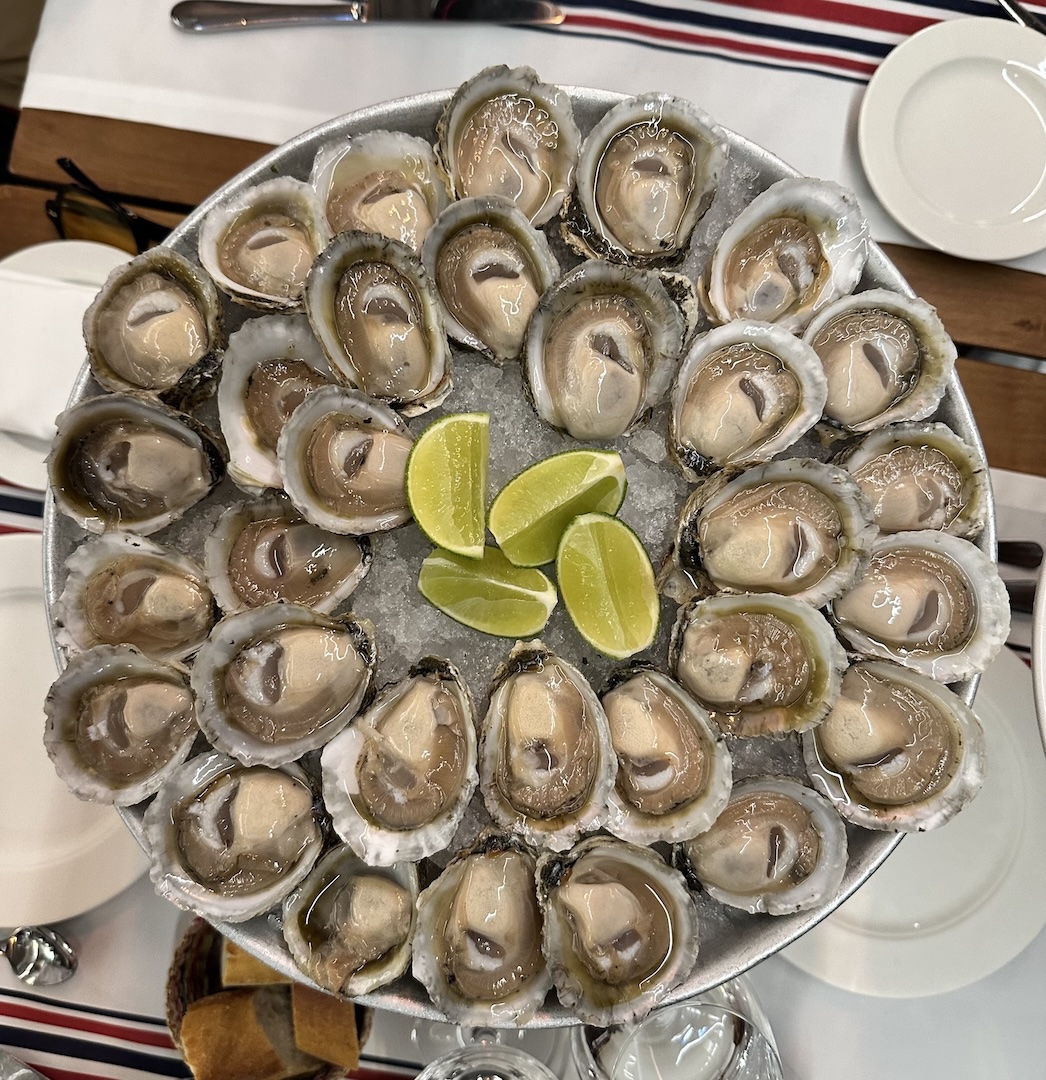
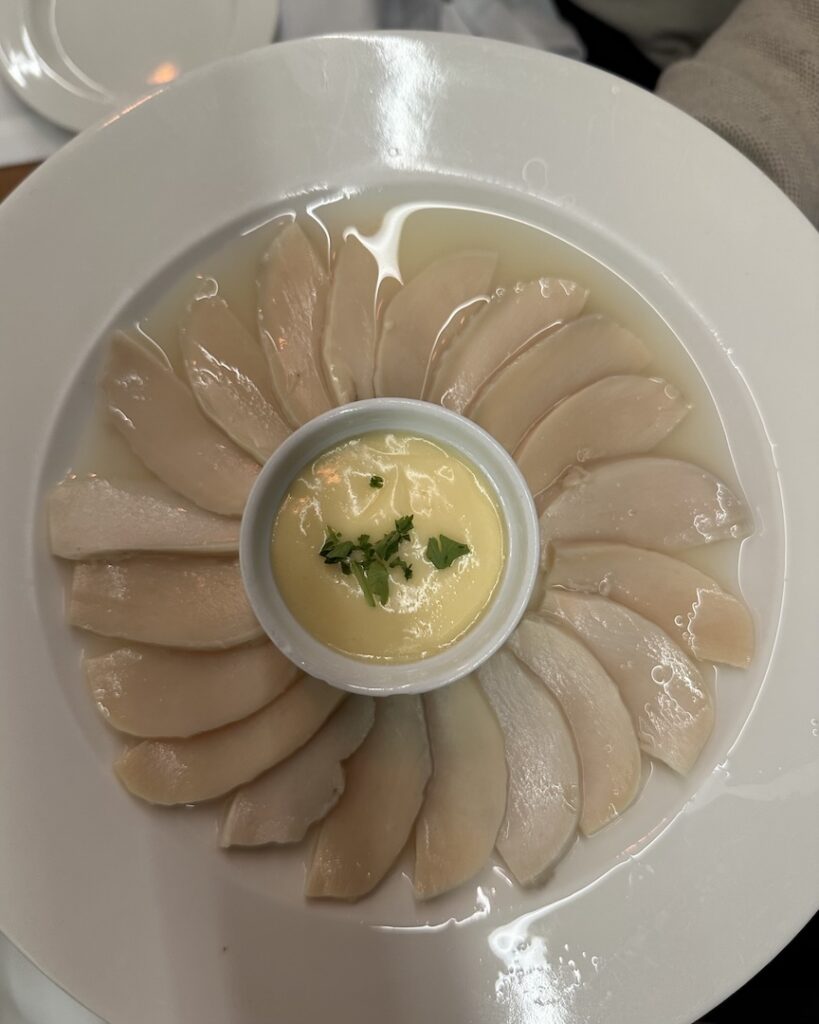
Dramatically switching gears, we headed to an upscale restaurant and wine bar nearby called Baco. First up: a massive tray of fresh Pacific oysters on the half shell, with shallot-and-vinegar mignionette as an optional topper. These are much smaller and more luscious that their Atlantic cousins and were similar to varieties I’ve had in the US PNW. Another dish was a plate of thin slices of oil-poached “locos,” the name for the local abalone. These were hauntingly rich and meaty, accompanied simply by freshly made mayo. We also ordered a piece of deep fried sea bass, a fish for which Chile is famous. It’s not a bass in any way, but a Patagonian tooth fish. Since it’s a cod relative, the flesh is firm, flaky and flavorful. Here, it’s not an exotic delicacy, but commonly stars in Chile’s fabulous fried fish sandwiches. Chile has some delicious wines, too. I had a Sauvignon Blanc with the seafood, then switched to a Cabernet Franc when the table ordered steak. Sadly, this trip was too brief and beery to dig much into the wine.
In and Around Valdivia
Valdivia is lush and beautiful, with rivers, lakes, wetlands and abundant birds, especially waterfowl. The signature bird of the region, the black-necked swan—cuello negro—lends its name to one of the larger and best-established craft breweries of the area. Pumas stalk the region, mostly feeding on a beagle-sized deer (the world’s smallest) called pudu.
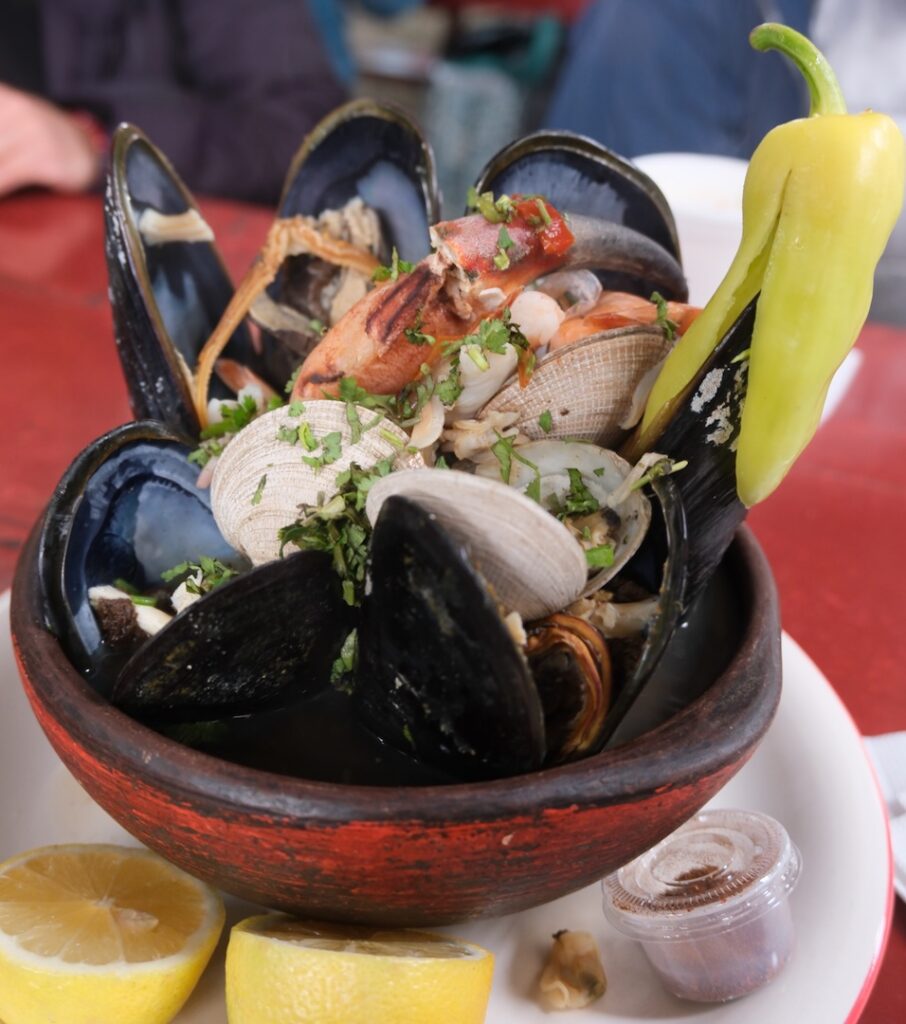
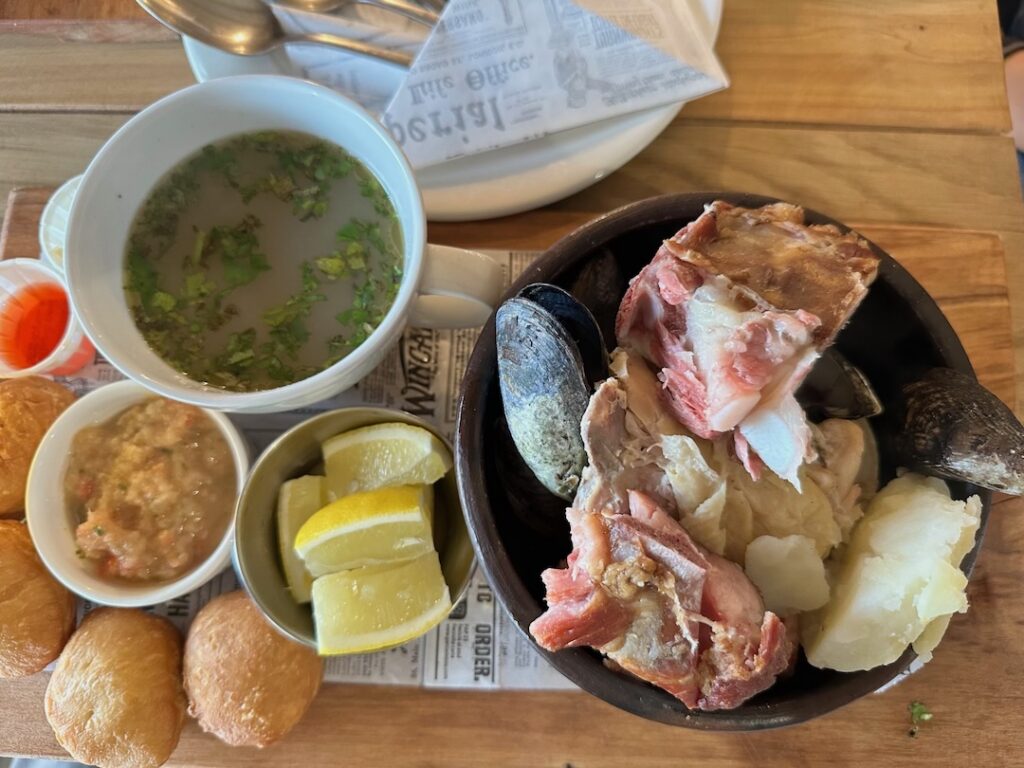
Upon arrival, I was whisked away by Patricio González, the Cuello Negro brewmaster, to their taproom in a beautiful riverside setting called Cutipay a few miles downstream from town. Since I had missed lunch distracted by various failed schemes to get ourselves unstuck from Santiago, I had a big bowl of a local specialty called pullmay—a kind of brothy fisherman’s stew, piled high with clams, mussels and shrimp, but there’s more. With typical Chilean abundance, the whole massive thing is topped with a chicken leg-thigh quarter, a bony chunk of cured/smoked pork and boiled potatoes.
Cuello Negro is most famous for its English style special bitter (amber), and Irish foreign stout, but I couldn’t taste them then. The beer competition I was there to help judge hadn’t started yet, so all of us who attended the reception that night were limited to a tasty conference collaboration: a dry-hopped lager that was pretty much a California Pils.
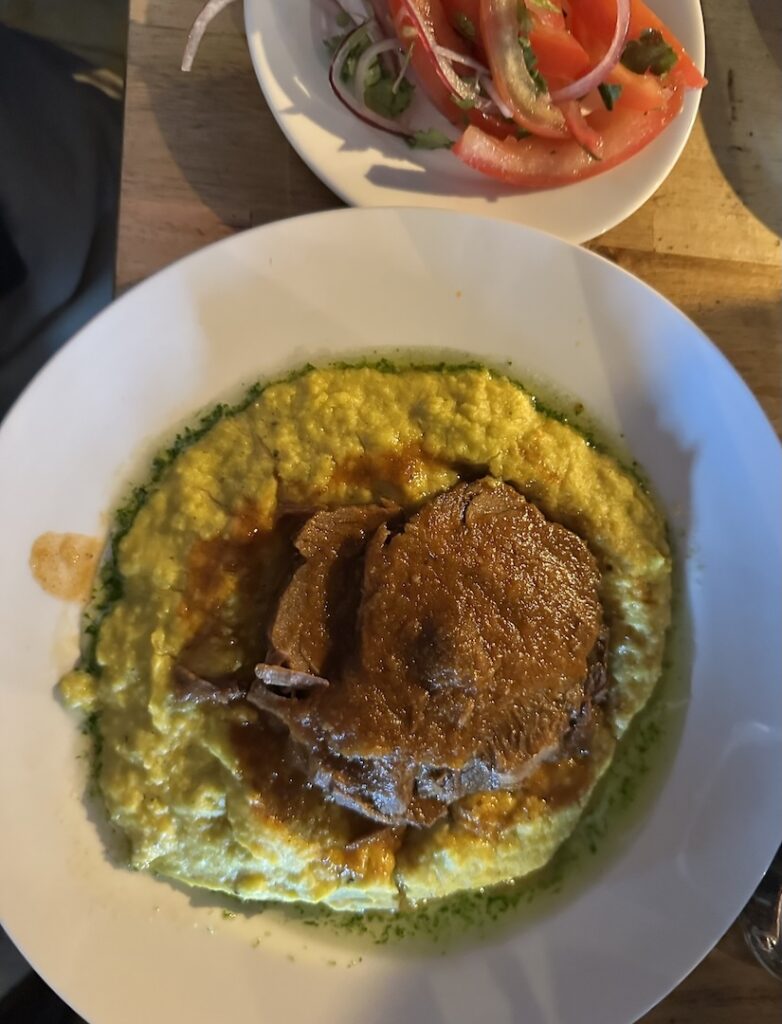
The judging schedule was typical: morning and afternoon sessions, separated by lunches, which were held at local brewpubs. The first day was at La Bota, which served us a variation on pastel de choclo: braised beef topping a kind of sweet corn pudding with a bit of chimichurri around the edge. There I was introduced to merken, a local seasoning made from smoked cacha de cabra (goat’s horn) chiles plus toasted coriander. It’s fairly spicy, just perfect for a table condiment. One could make a passable version by grinding up chipotles and mixing them, 3:1 with coriander seeds toasted long enough to become aromatic, then ground. I eventually bought a kilo at the river market to bring home for my chile-head friends. The next day’s lunch started with a very Chilean fried mashed potato patty with ground meat inside, followed by braised chicken with mashed potato and peas, the kind of dish you could have been served at an Amish restaurant in Ohio.
Tuesday was a beer and food pairing dinner at Cuello Negro’s taproom. I was supposed to speak, but Patricio and his chef had worked everything out beforehand, so I was wondering what I could add, maybe just point out some of the ways the pairings were working. When all 35 or so people were seated, at least a third of them turned out to be beer judges, a perfect opportunity to have the audience tell each other what was going on, with a little preamble and prompting from me. People are normally too unconfident to just shout things out, but the judges and others didn’t hold back. We had a lively and enlightening conversation and we all learned a lot. If you can make this work, it really is the best. If you just stand there and tell people what they’re going to experience, they’ll stop right there. If you make them work for it, they really get a lot more engaged. Kudos to Patricio and his chef team. It was a blast.
Up the Hill
Wednesday, as a respite for the judges, we were bussed three hours into the misty mountains to Volcán Villarrica, an area famous for hot springs. This whole region is a very rainy place, with the air dropping its oceanic moisture as the wind pushes it up the mountain. We pulled into small resort with a big pool in the back and a restaurant in front. After a gut busting meal of meat and potatoes washed down by a couple of beers, everyone went out to the pool, changed into bathing suits and hopped in, rain be damned.
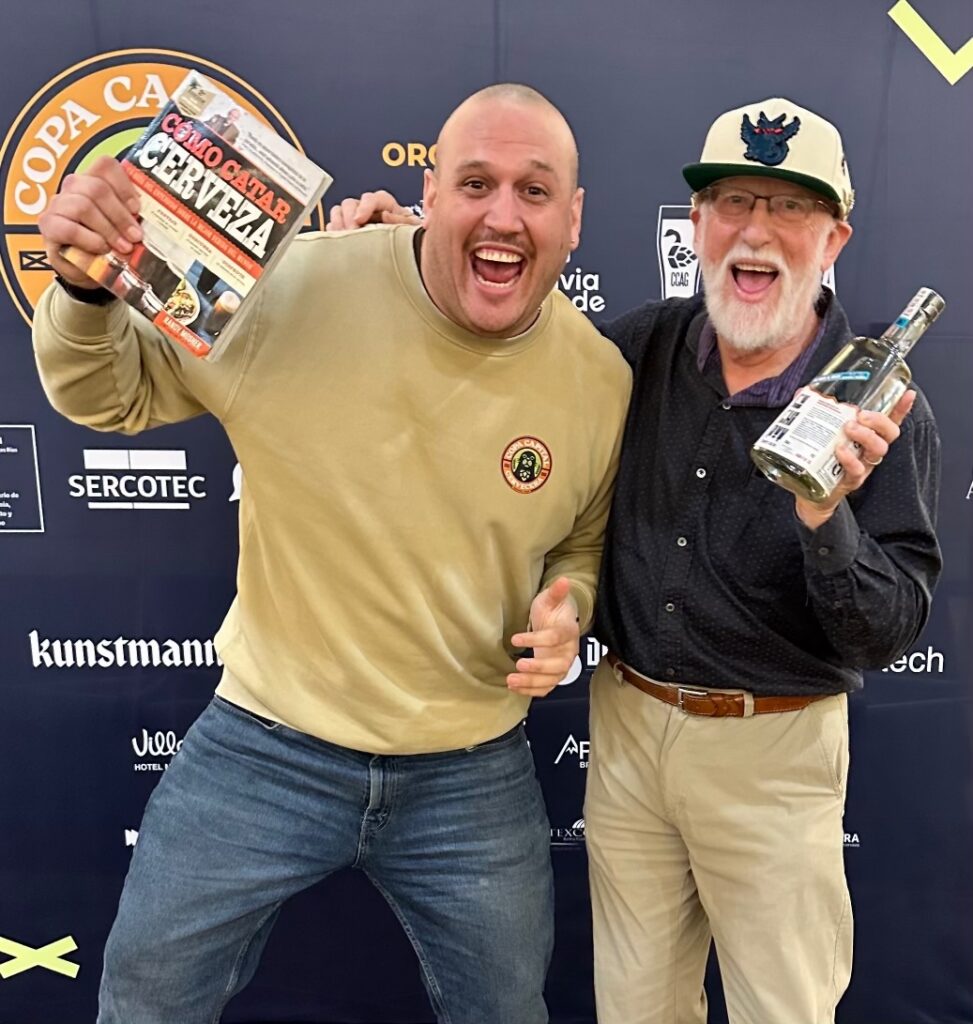
There’s a special camaraderie, a kind of instant community, that often forms with these judging groups. People are just so excited to be together. There were about 20 of us. There’s a lot of laughter, everybody’s still drinking beer and a brewer named Peter was passing around a bottle of Cu Chi Puy gin (named after a local monster) made with sunflower seeds at his brewery/distillery, Agua y Sol. It was a warm out-of-body experience. You never know where you are going to find yourself when you travel. Especially with beer people. Especially in Latin America. I told them later it was like an orgy but without all the sex.
Final Fling
Thursday was a day of seminars, with several of us giving presentations. Lunch was at El Regreso Beer Co., a brewpub that is mad for mushrooms. I had a sandwich featuring a deep-fried clump of oyster mushrooms that was quite tasty.
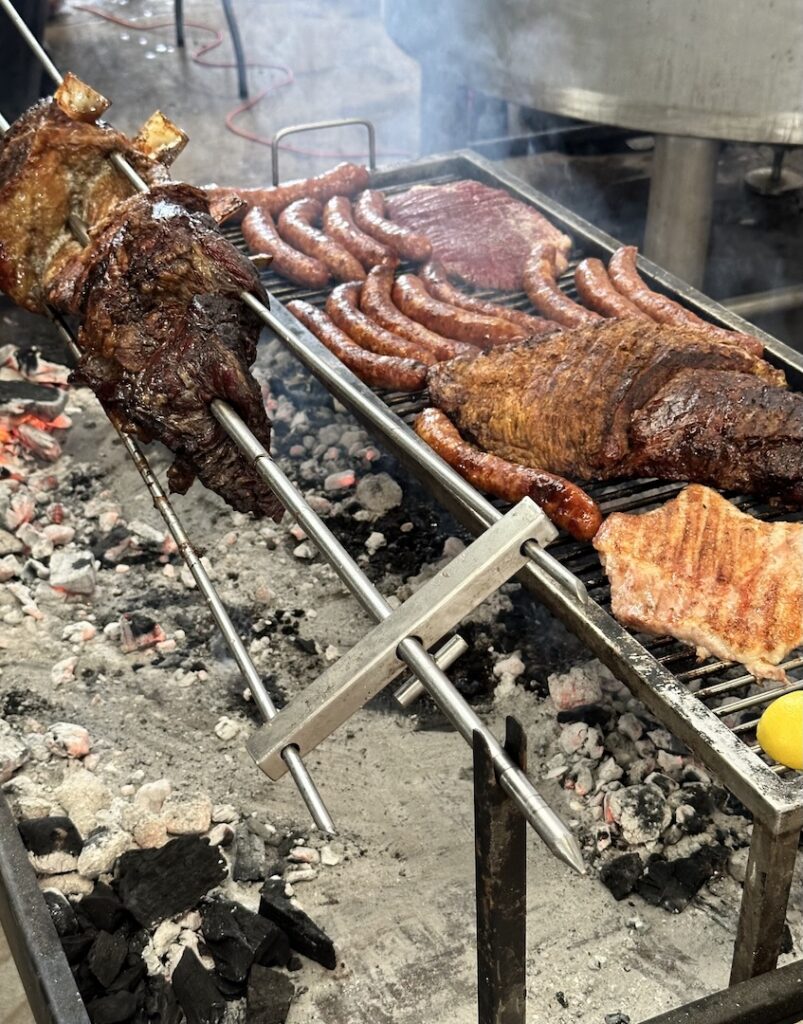
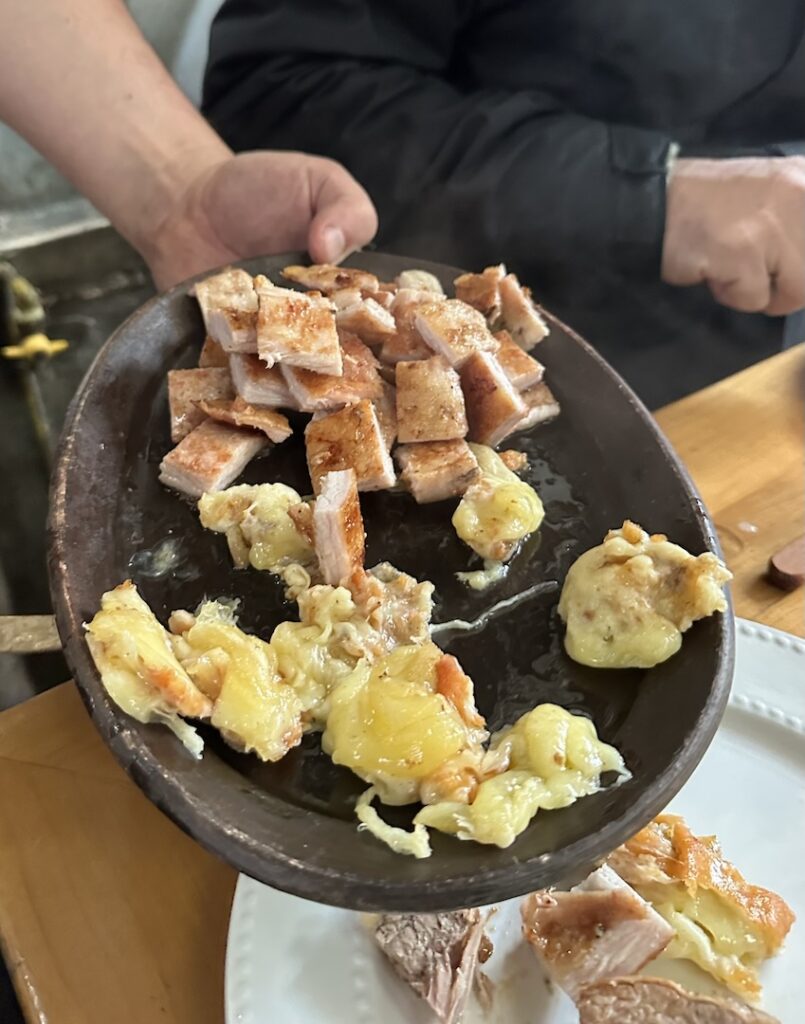
Friday I was called upon to deliver a mini tasting lecture for the entire Cuello Negro staff. The 30 hectoliter production brewery is a few miles out of town in a park-like setting ensconced in a mostly residential neighborhood. The reward, after running everyone through a couple of beers, was asado: South American style live-fire barbecue. This, as is the norm way down south, is mixed meats: A gnarly knob of beef that had been on the spit for while when I got there, a hunk of flank steak, some thin pork belly described as “diaphragm,” served in small squares with melted cheese, and of course chorizo for choripan.
I had just a little time Friday afternoon to set foot in Valdivia’s city center, across the river from where we were staying amidst the shipyards. Valdivia is most famous for being the site of the world’s largest recorded earthquake, a monster of 9.5 magnitude that occurred in 1960. Downtown’s position atop a a rocky knob saved it from total devastation, but it was bad. Large portions of the area subsided by up to two meters during the quake, making the area even swampier that it was before, ruining a lot of farmland and cursing the airport with irksome fog. With a bunch of active volcanos, this area is a very lively part of the vast “Ring of Fire” that encircles the Pacific Ocean.
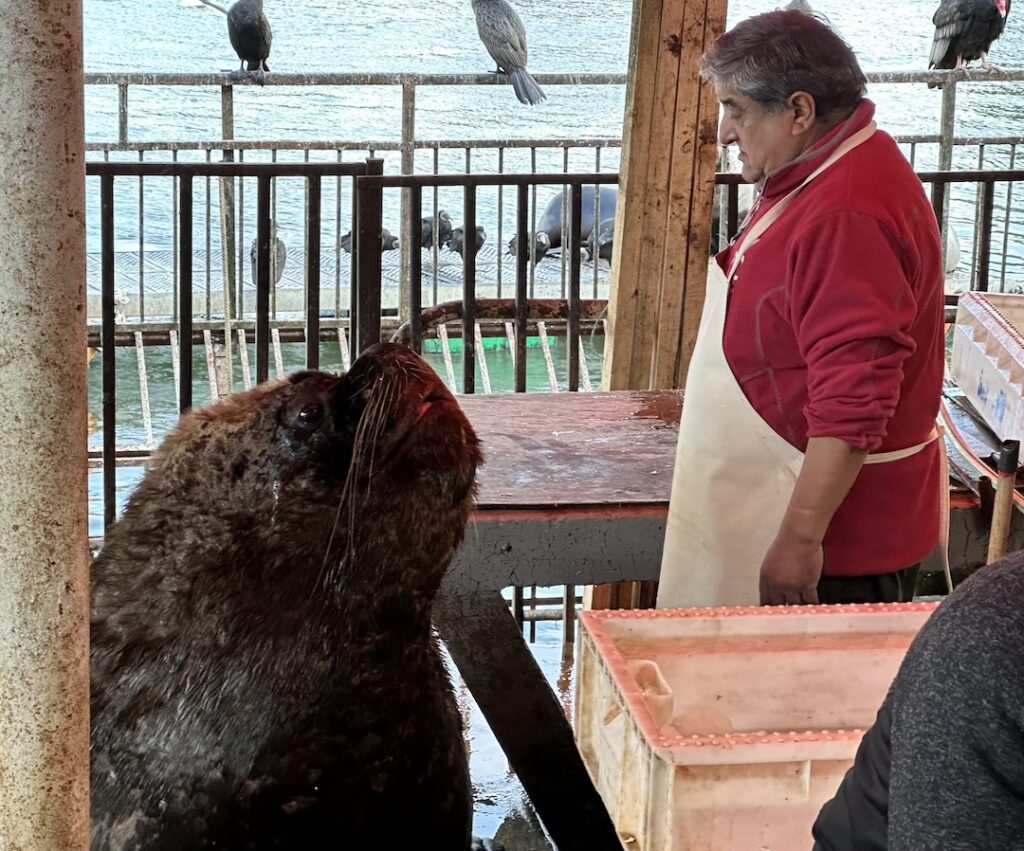
I had a quick peek at the town. The excursion docks at the north were also a kind of theater for strutting “sea wolves” as they call them. The males are huge; one is famous for striking cute poses with tourists. The shops were typical, with a butcher shop being especially appetizing. Cowboy country isn’t far away, so in addition to the seafood, that’s the most characteristic cuisine.
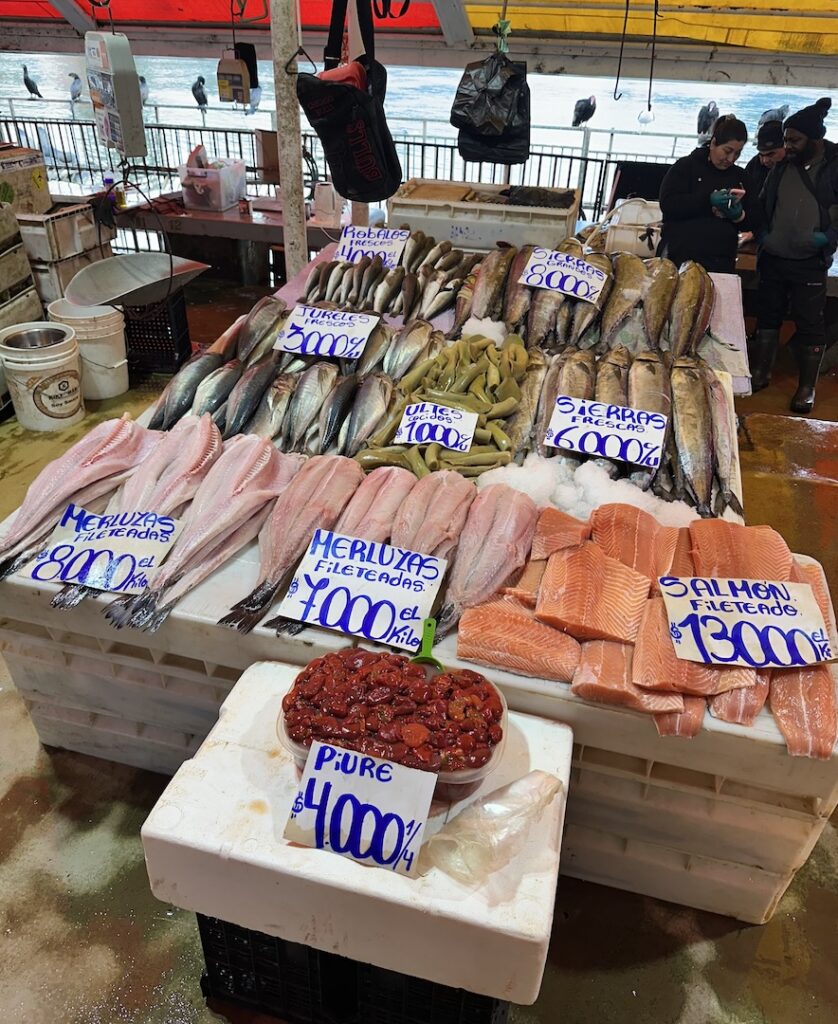
On the river is a huge seafood and produce market. The sea wolves hang around the fish cleaning station, waiting patiently for a treat. I wish I could have brought everything home.It’s clear that some fishmongers and sea wolves have long established relationships. I hit a small mall on my way back to the hotel and managed to snag a massive Chilean cookbook and a bottle of Provencia Patagonian gin. I’m fascinated by gin and the creativity distillers around the world show by including local botanicals, although I don’t drink a lot of it. My friends benefit.
I had just a little time Friday afternoon to set foot in Valdivia’s city center, across the river from where we were staying amidst the shipyards. Valdivia is most famous for being the site of the world’s largest recorded earthquake, a monster of 9.5 magnitude that occurred in 1960. Downtown’s position atop a a rocky knob saved it from total devastation, but it was bad. Large portions of the area subsided by up to two meters during the quake, making the area even swampier that it was before, ruining a lot of farmland and cursing the airport with irksome fog. With a bunch of active volcanos, this area is a very lively part of the vast “Ring of Fire” that encircles the Pacific Ocean.
I had a quick peek at the town. The excursion docks at the north were also a kind of theater for strutting “sea wolves” as they call them. The males are huge; one is famous for striking cute poses with tourists. The shops were typical, with a butcher shop being especially appetizing. Cowboy country isn’t far away, so in addition to the seafood, that’s the most characteristic cuisine.
On the river is a huge seafood and produce market. The sea wolves hang around the fish cleaning station, waiting patiently for a treat. I wish I could have brought everything home.It’s clear that some fishmongers and sea wolves have long established relationships. I hit a small mall on my way back to the hotel and managed to snag a massive Chilean cookbook and a bottle of Provencia Patagonian gin. I’m fascinated by gin and the creativity distillers around the world show by including local botanicals, although I don’t drink a lot of it. My friends benefit.
By then the beer festival was in full swing. We judges made an appearance during the awards and they handed out framed caricature portraits to all of us. I usually think awards presentations are among the most boring things on the planet, but the excitement here was truly contagious and really fun to witness.
One question the foreign judges get a lot is “How is the beer?” Most of the time, the best beers are truly world class, and Chile was no exception. There weren’t many problem beers in the competition, although as is typical, some might have been better entered in a different category. Really small brewers and brewpubs who don’t package struggle to get their beers to the competitions in good shape. As another data point, all the beers I had in bars and brewpubs were well-brewed and tasty.
A few of us went into town in search of food. First stop was Das Haus, a German pub specializing in crudo (raw ground beef) and sandwiches. Afterwards, we visited a very nice cocktail spot, 55 Bar and Cocina, just across the bridge to the north. Cool place, hip vibe, solid drinks. Appetizers were fantastic also.
The last day Patricio took me and some friends to the coast, which holds an ancient Spanish fort guarding the mouth of the river. Conditions must have been harsh, which just shows how desperate people were to improve their situations in the Old World. Nearby was a huge seafood market that was really a giant food court specializing in asado, empanadas and a multitude of seafood dishes like the pullmay I had the first day. I got the paila version without the chicken and pork, but it was still a feast, including mussels the length of my hand that they call “mussels for chewing.” I also had a kind of cheesy crab casserole called pastel de jaiba.
And that was that. While this is just one newcomer’s very brief experience, it’s amazing how much you can learn if you travel in good company, with your eyes open. Thanks to Patricio and Cuello Negro for bringing me down there, and to all my new South American friends for making this such a rewarding experience.